Which residential pool filter type best fits a homeowner's priorities?
Cartridge filters avoid backwash water, sand filters offer straightforward service with coarser filtration, and DE filters can capture finer particles but require careful media handling and model-specific maintenance. The best choice fits local water constraints, desired clarity, service tolerance, and the rest of the circulation system.
Cartridge, sand, and diatomaceous-earth filters can all support clear residential pool water when correctly sized, operated, and maintained. They differ in particle capture, backwash water, hands-on service, disposal, pad layout, and failure modes. The best filter is the one that fits the pool, local water constraints, owner maintenance tolerance, and circulation system—not the type with the most impressive single specification.
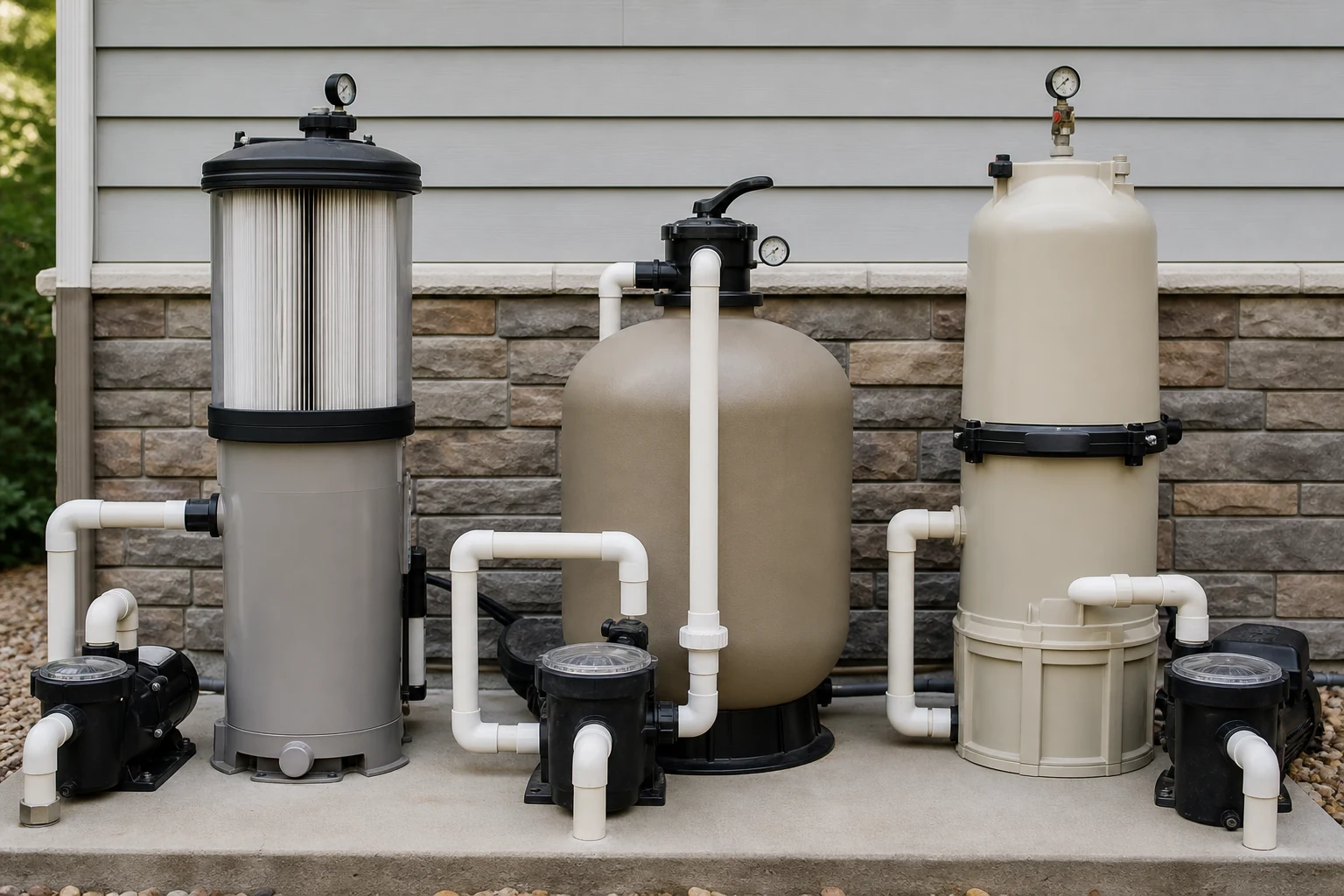
What filtration can and cannot do
A filter removes suspended particles that reach it. It does not disinfect the water, correct pH, brush algae from walls, or guarantee circulation in dead zones. A finer nominal micron claim may improve capture of small particles under test conditions, but real clarity also depends on flow, media condition, bypass, run time, chemistry, and cleaning.
Oversizing filter area generally reduces loading rate and can extend time between service. Undersizing causes rapid pressure rise and frequent maintenance. Match the filter’s design flow and pressure limits to the pump curve and every planned operating mode.
Cartridge filters
Cartridge filters use pleated removable elements. EPA WaterSense identifies them as water-efficient because they do not need backwashing. Routine service involves shutting down and fully depressurizing the vessel, removing the cartridges, rinsing debris from the pleats, inspecting damage, and reassembling the tank correctly.
They work well where backwash discharge is restricted or water is expensive. Large cartridge area can provide long intervals between cleanings at modest flow. The tradeoffs are hands-on teardown, storage or replacement of bulky elements, and the need to remove oils or mineral deposits using approved procedures.
A high-pressure washer can damage pleats. A torn element or poor seal can let debris bypass. Owners must be comfortable opening a pressure vessel safely or pay for service.
Sand filters
Sand filters pass water through a bed of graded media. They are familiar, durable, and usually simple to operate. Many are cleaned by backwashing through a multiport or push-pull valve, then rinsing before returning to filtration.
Backwashing uses pool water, so local discharge rules and drought conditions matter. EPA’s residential pool guide describes sand filtration as coarser than cartridge and DE in typical comparisons, but the actual result depends on design and operation. A properly operating sand filter can maintain a clear home pool without chasing the finest micron claim.
Never move a multiport valve while the pump is running. Backwash only when pressure or flow indicates need. Old sand is not automatically bad; channeling, calcification, incorrect media, a broken lateral, or a valve gasket can be the real fault.
DE filters
DE filters coat internal grids or fingers with fine diatomaceous-earth media and typically provide fine particle capture. They can be useful when very polished water is a priority. That performance comes with more involved service.
After backwashing, many DE filters require a measured charge of new media. Operating without enough coating can foul the fabric; too much can raise pressure. Periodic disassembly is needed to inspect grids, manifolds, and seals. DE dust should not be inhaled, and disposal is restricted in some locations.
Alternative media can be used only when the filter manufacturer permits it. A product being marketed as a drop-in replacement does not override the equipment manual or local rules.
Compare the water and labor footprint
Cartridge cleaning uses hose water but no backwash cycle. Sand filters can discharge a substantial volume each time they backwash. DE systems also backwash on many models and require replacement media. The best local option depends on water cost, discharge access, drought rules, and how dirty the pool becomes.
Labor matters just as much. A cartridge owner lifts and rinses elements. A sand owner operates a valve and occasionally investigates media or internals. A DE owner handles media and performs careful grid service. Get a service quote for each type if you will not maintain it yourself.
Consider the pad and the whole system
Measure equipment-pad space and service clearance. Cartridge lids need vertical room. Sand tanks are heavy and require access if media is ever removed. DE grids need room for teardown. All types need a readable pressure gauge and working air relief.
Check pump flow at every programmed speed, heater requirements, plumbing size, automation, waste routing, and winterizing needs. A filter replacement may require new unions or valve arrangements. Have a qualified installer evaluate any tank that is cracked, sun-damaged, corroded, or operating above its rating.
Use clean pressure as the maintenance trigger
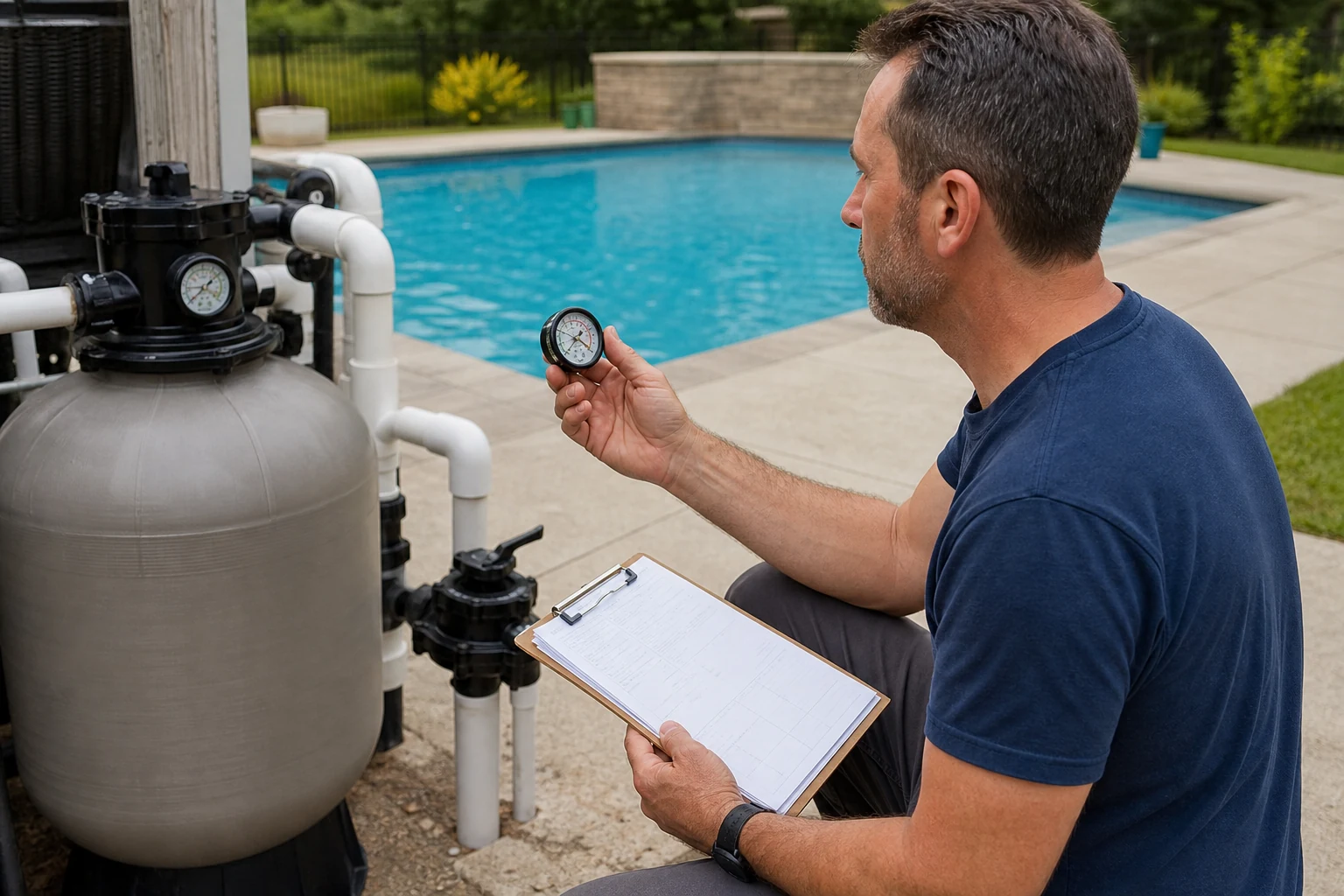
Record pressure after correct service at a documented pump speed and valve position. Monitor the increase and changes in return flow. Follow the manufacturer’s criterion for cleaning or backwashing. A universal “ten psi” rule should not replace the manual.
If pressure stays high after service, look for blocked returns, misassembled elements, too much DE, valve problems, or a bad gauge. If pressure is low, inspect suction, baskets, water level, impeller, and pump operation.
Final takeaway
Choose cartridge for low backwash water and acceptable teardown, sand for straightforward durable operation with a legal waste route, or DE when fine capture justifies more complex media handling. Size generously, respect flow limits, and budget for the maintenance you will actually perform. Clear water comes from the complete system, not the filter label alone.
Sources and Supporting Claims
U.S. Environmental Protection Agency WaterSense
Published 2022-09-01
- Pool filter types differ in particle capture, maintenance, and backwash water use.
- Cartridge filters do not require backwashing.
- Pool covers and equipment choices affect water and energy efficiency.
U.S. Environmental Protection Agency WaterSense
Published 2026-06-01
- Skimming and vacuuming reduce load on filtration.
- Filters should be cleaned based on need and pressure rather than an arbitrary schedule.
- Pool equipment and plumbing should be drained before freezing weather where applicable.
- Automatic-fill systems should be monitored for leaks.
Pentair
- Filter disassembly and reassembly are safety-sensitive and model-specific.
- Poor clarity can reflect sanitizer, flow, sizing, media, or installation problems.
- The installed equipment manual controls service procedures.