What should homeowners compare when choosing a robotic pool cleaner?
Match a robotic cleaner to pool length, shape, surface, steps, wall and waterline needs, debris type, retrieval weight, power arrangement, warranty, and parts support. Marketing features matter less than verified coverage and a safe, maintainable fit.
A robotic pool cleaner should be matched to the pool, not to a feature list. Confirm pool length, shape, finish, slopes, steps, benches, drains, wall and waterline needs, and the debris you actually collect. Then compare filtration, cord or battery limits, retrieval weight, safe power placement, warranty, parts, and local service.
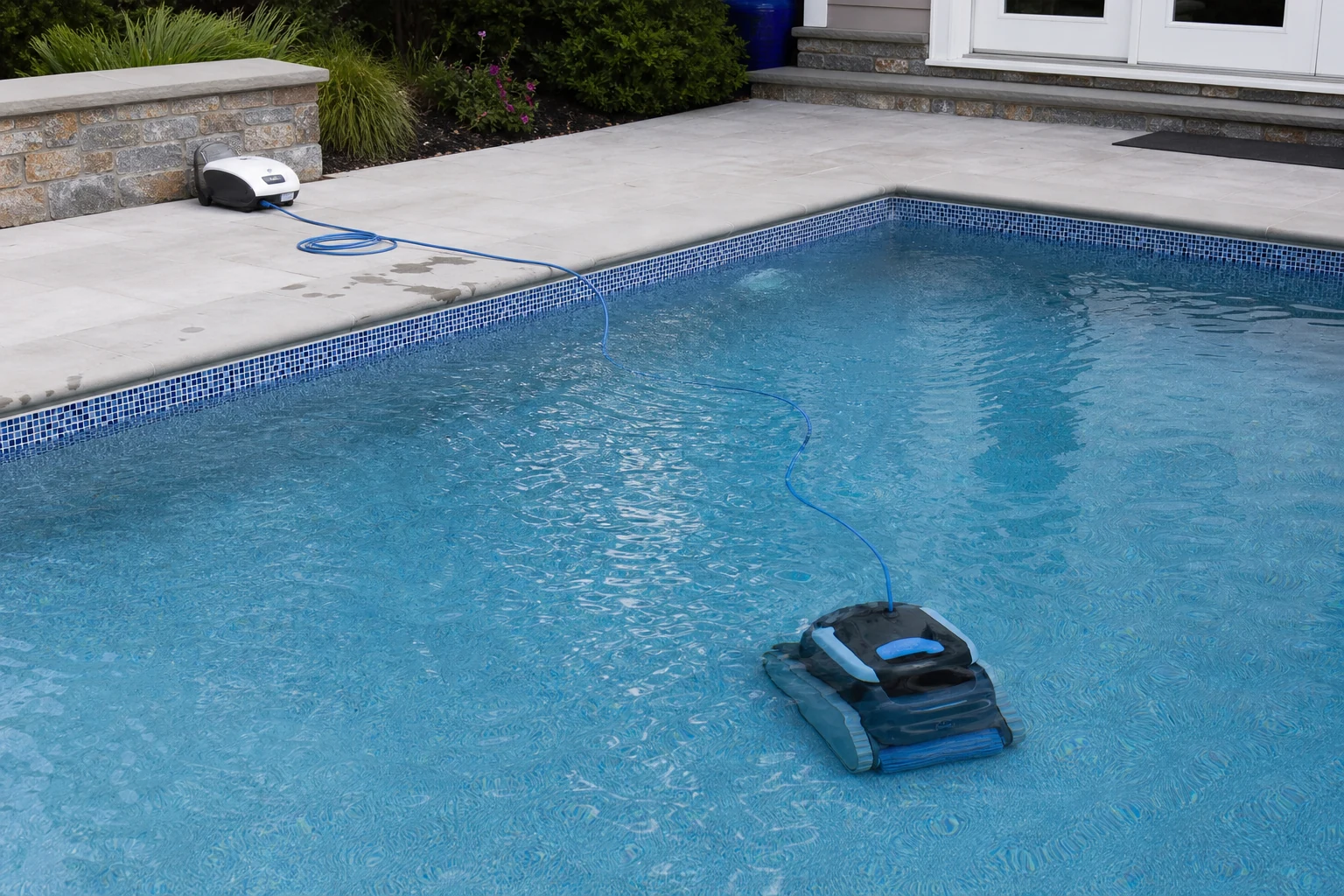
Map the pool before comparing models
Measure maximum length, width, and depth. Note a beach entry, sharp transitions, a deep hopper, curved walls, narrow lanes, raised drains, steps, benches, a tanning ledge, and an attached spa. Photograph obstacles.
Manufacturers rate cleaners for different pool types and lengths. Maytronics’ selection guidance highlights pool size and surface as core inputs. A model that performs on a rectangular plaster pool may struggle with a soft-sided above-ground pool, unusual tile, tight steps, or a large ledge.
Ask whether the cleaner covers floor only, floor and walls, or floor, walls, and waterline. “Wall climbing” does not guarantee step or ledge cleaning.
Match filtration to debris
Large leaves and acorns need a basket that accepts bulky material without clogging. Fine dust, silt, pollen, or dead algae need finer media. Some systems offer interchangeable or layered filters. Compare usable filter area, access, cleaning effort, and replacement cost.
The robot’s internal filter does not replace the pool circulation filter or chemical maintenance. It removes material it encounters during a cycle. Water that remains cloudy may need improved chemistry, circulation, or main filtration.
Corded versus cordless
Corded cleaners can run without a battery-time limit, but the cable must reach the pool without an extension cord and be managed to reduce tangling and trip hazards. The power supply must be placed at the distance and elevation required by the manual and connected to a suitable GFCI-protected circuit.
Cordless models avoid a floating cable but introduce battery capacity, charging time, battery aging, retrieval after shutdown, and charger storage. Confirm the cycle time against pool size and whether the battery can be serviced or replaced.
No cleaner should operate with swimmers present unless its manufacturer expressly allows it. Many manuals require removal before swimming.
Consider handling after the cycle
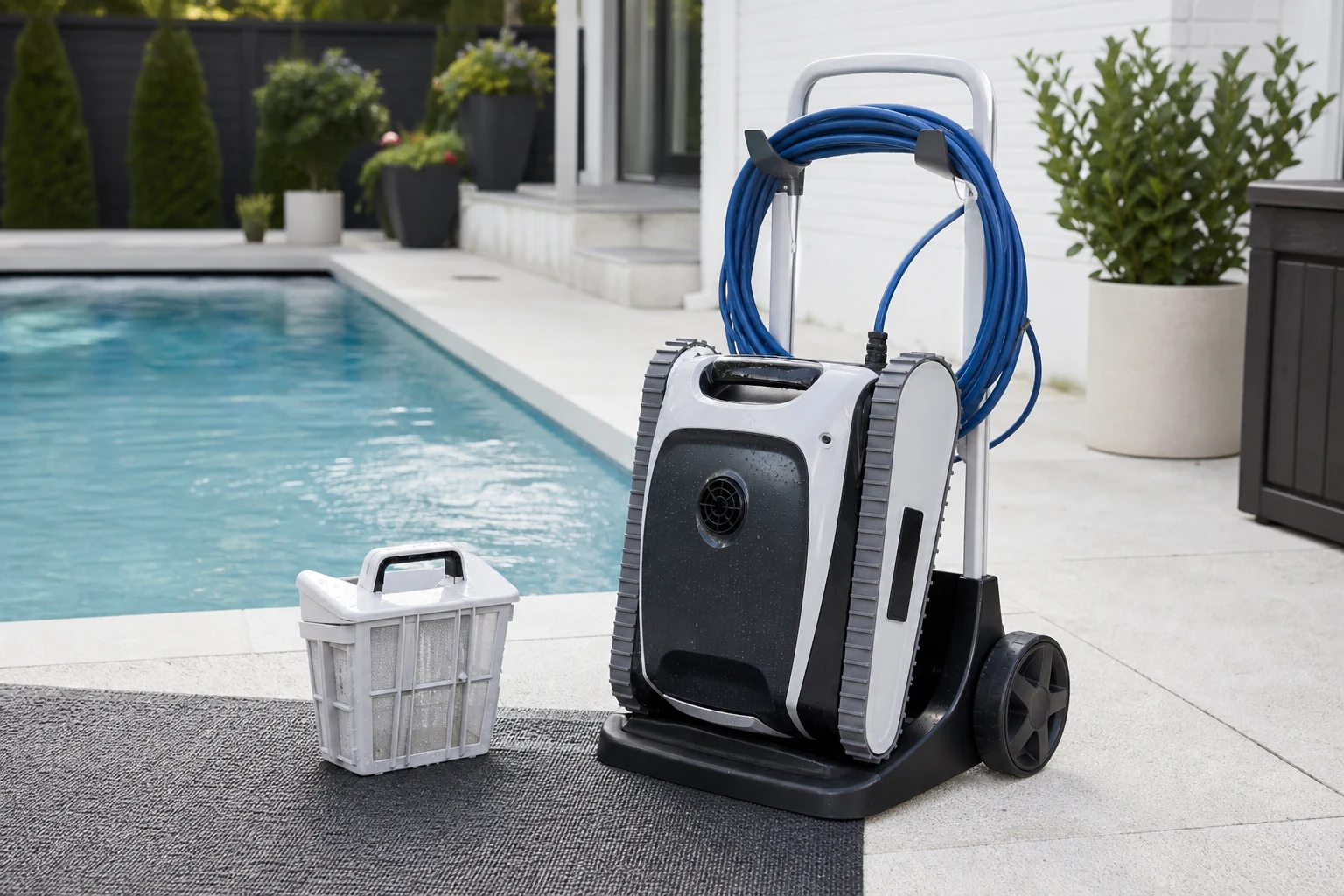
Retrieval is part of every use. Check dry and water-filled weight, handle position, caddy availability, and the route from pool to storage. Pull using the designated cable method only as instructed; do not lift a corded unit out by its cable.
Open and rinse the filter after each dirty cycle. Inspect brushes, tracks, impeller access, cable, seals, and sensors. Store the cleaner out of direct weather and extreme temperatures according to the manual. A machine that is inconvenient to clean will be neglected.
Evaluate navigation and controls realistically
Sensors, scanning, gyroscopes, and software can improve coverage, but no consumer robot can promise every square inch of every geometry. Ask for a return policy or demonstration if the pool has difficult features.
App control, schedules, spot modes, and remote status can be useful. They do not matter if wireless coverage is poor, the cleaner cannot reach a ledge, or the filter is too small for the debris. Confirm whether essential start and mode controls work locally without a cloud service.
Check warranty, parts, and service
Read the warranty before purchase. Note coverage period, labor, shipping, battery exclusions, wear items, commercial-use exclusions, and requirements for authorized service. Search for current prices and availability of baskets, brushes, tracks, cables, motors, chargers, and batteries.
A cheaper model replaced every few seasons may cost more than a repairable unit. Conversely, premium navigation has little value if the local dealer cannot service it. Ask who diagnoses the cleaner and how long typical repairs take.
Fit the electrical and safety environment
Inspect the outlet, GFCI, bonding, deck drainage, and storage path. Do not use a household extension cord at the pool. Replace damaged cables and power supplies rather than taping them. Stop use if the GFCI trips repeatedly, a cable jacket is cut, the power supply gets wet, or swimmers feel tingling.
Keep the caddy and cable out of walkways. Remove toys, loose cords, and objects that could jam the robot. Secure the pool against unsupervised child or pet access; a cleaner is not a safety device.
Ask better comparison questions
For each candidate, record: compatible pool type and finish; maximum size; floor, wall, waterline, step, and ledge coverage; filter options; cycle time; cord or battery; retrieval weight; power-supply placement; app dependence; warranty; parts; and service location.
Avoid ranking models solely by advertised suction, number of motors, or retail discount. Those numbers may not predict coverage or maintainability.
Final takeaway
The right robot fits the pool’s geometry, finish, debris, power environment, and owner’s willingness to retrieve and clean it. Verify coverage, filtration, safe electrical setup, serviceability, and parts before paying for smart features. A good match reduces manual work; it does not replace water care, brushing, or supervision.
Sources and Supporting Claims
Maytronics
- Pool size, surface, and desired level of automation are core cleaner-selection inputs.
- Model capabilities must be matched to the actual pool.
Maytronics
- Swimmers should not be in the pool while a robotic cleaner is operating.
- Power, GFCI, cord, retrieval, and service precautions are model-specific.