How should a homeowner choose and size a pool pump?
Do not size a pump from pool volume or horsepower alone. A qualified installer should match the pump's performance curve to system head, the filter and heater flow limits, plumbing, water features, and local rules, then program the lowest speeds that reliably perform each task.
A pool pump should be selected as part of a hydraulic system, not by buying the largest horsepower that fits the pad. The pump must deliver the flow required for filtration, heating, sanitation, cleaning, and water features while staying within the limits of the filter, heater, pipework, drains, electrical supply, and local code. A variable-speed model then lets the owner use lower flow for long routine tasks and higher flow only when a function needs it.
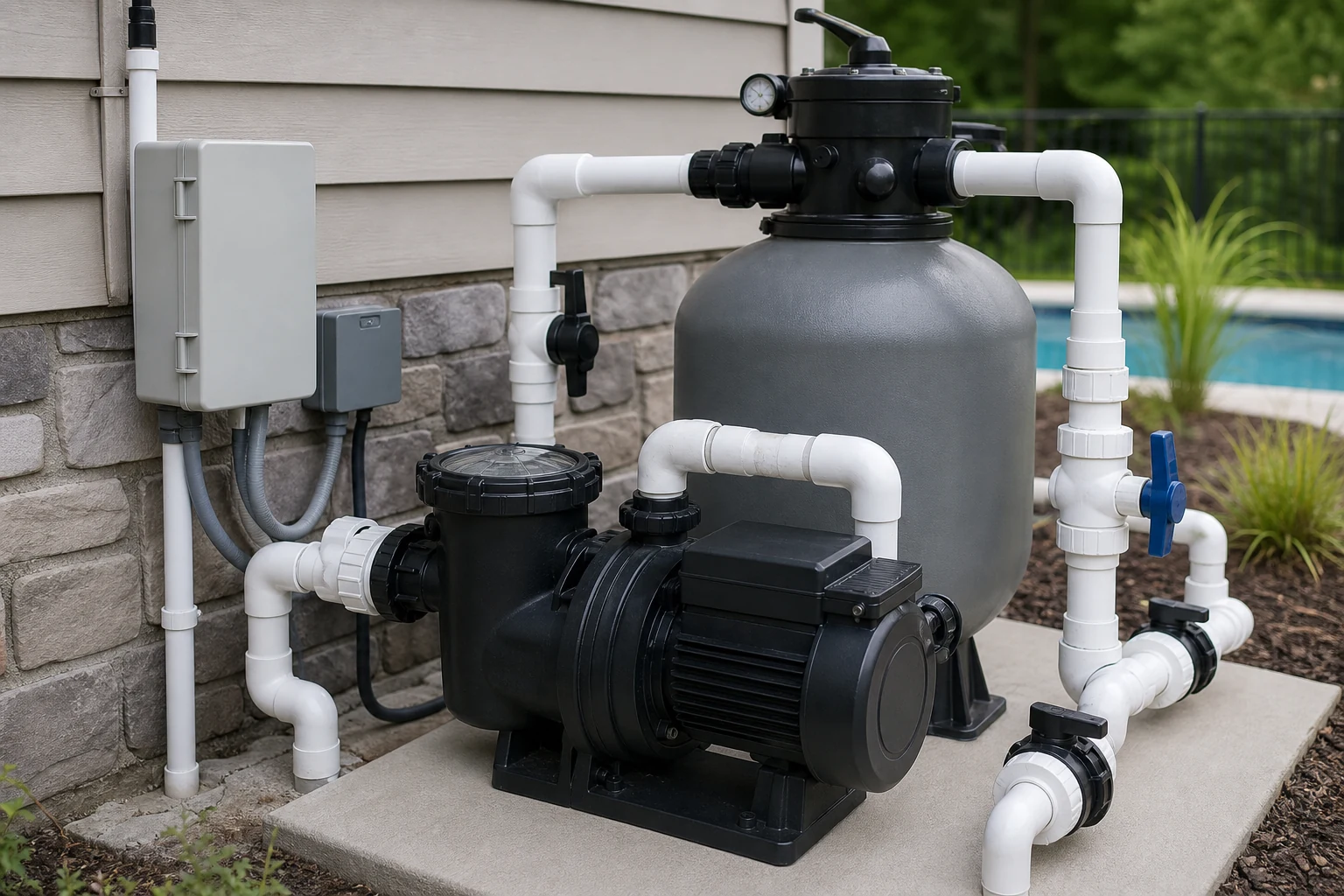
Start with the functions the pump must serve
List every hydraulic task: basic filtration, skimming, heater operation, saltwater chlorine generation, suction or pressure cleaning, spa jets, waterfalls, solar heating, and in-floor cleaning. Each can have a minimum or preferred flow and may use a different valve position.
Do not combine all maximums and assume the pump must provide them at once. Automation often schedules functions separately. The design goal is to satisfy each real mode without exceeding another component’s limit.
Pool volume is only one input
Volume helps estimate circulation needs, chemical doses, and how long a selected flow would take to move a quantity of water. It does not reveal pipe resistance or guarantee uniform mixing. Two 15,000-gallon pools can need different pumps because one has short two-inch plumbing and the other has long, restrictive lines, a rooftop solar loop, and multiple features.
“Turnover” rules for public venues or old rules of thumb are not a substitute for residential system design. Water quality depends on sanitation, mixing, filtration, cleaning, and swimmer load together.
Understand system head and the pump curve
As water moves through pipe, fittings, valves, filters, heaters, and elevation changes, the system resists flow. That resistance is expressed as head. A pump curve shows the flow a particular pump can produce at different head values.
An installer estimates or measures the system curve and finds operating points on the pump’s performance data. Horsepower alone cannot do this. Motor labels may use rated, service-factor, total, or hydraulic horsepower in ways that make casual comparison misleading.
The selected operating point must respect the filter’s design-flow limit, heater minimum and maximum flow, pipe velocity guidance, suction-outlet requirements, and the limits of chemical or solar equipment. Oversizing can create noisy plumbing, high filter pressure, poor heater behavior, and wasted energy.
Why variable speed matters
ENERGY STAR explains that filtration usually needs less flow than high-demand tasks and that reducing pump speed can sharply reduce power use. The relationship is not a fixed savings promise for every installation, but the principle is powerful: moving water more slowly for longer can perform routine filtration with less power, less noise, and lower stress.
A useful program might use a low speed for filtration and chlorine generation, a medium speed when the heater or skimmer needs more flow, and a temporary higher speed for cleaning or a feature. Determine each setting from actual performance, not copied internet RPM values.
Check the rest of the equipment
Read nameplates and manuals for the filter, heater, salt cell, cleaner, solar controller, flow switch, automation, and valves. Note required flow, maximum pressure, pipe size, voltage, breaker, and communication support. Replacing a pump can expose an undersized filter or incompatible controller.
Inspect suction outlets and drain covers. Entrapment protection and local code must be satisfied. A new pump should never be used to compensate for a blocked line or damaged suction fitting.
Plan electrical and physical installation
Pool pumps operate in a wet environment and require code-compliant wiring, grounding, bonding, disconnects, and GFCI protection where applicable. Use a qualified pool electrician or licensed contractor. A motor that can be wired for more than one voltage must be configured correctly; guessing can destroy it or create a shock hazard.
The pad needs drainage, ventilation, service clearance, stable support, and pipe alignment that does not load the pump housing. Weather protection must not trap heat. Unions and valves should allow service without draining unnecessary water, but extra fittings add resistance.
Commission the pump with measurements
After installation, confirm correct valve positions, prime according to the manual, release filter air as directed, and stand clear of the pressure vessel. Check leaks, flow, filter pressure, heater or salt-cell flow status, skimming, and sound at each programmed speed.
Record watts or amperage if the controls provide trustworthy readings, plus RPM, filter pressure, valve position, and which functions work. Adjust to the lowest speed that reliably meets each purpose with a reasonable margin. Confirm that freeze protection and schedules work locally even if cloud or internet control fails.
Avoid common buying mistakes
Do not select by advertised maximum flow without the corresponding head. Do not assume a larger pump cleans better. Do not reuse an old single-speed run time with a new variable-speed pump without testing. Do not ignore the cost of controls, wiring, plumbing changes, permits, and commissioning.
Ask bidders for the exact model, performance curve, hydraulic assumptions, efficiency rating, warranty conditions, included electrical work, and startup settings. A transparent design is more valuable than a vague promise of “more power.”
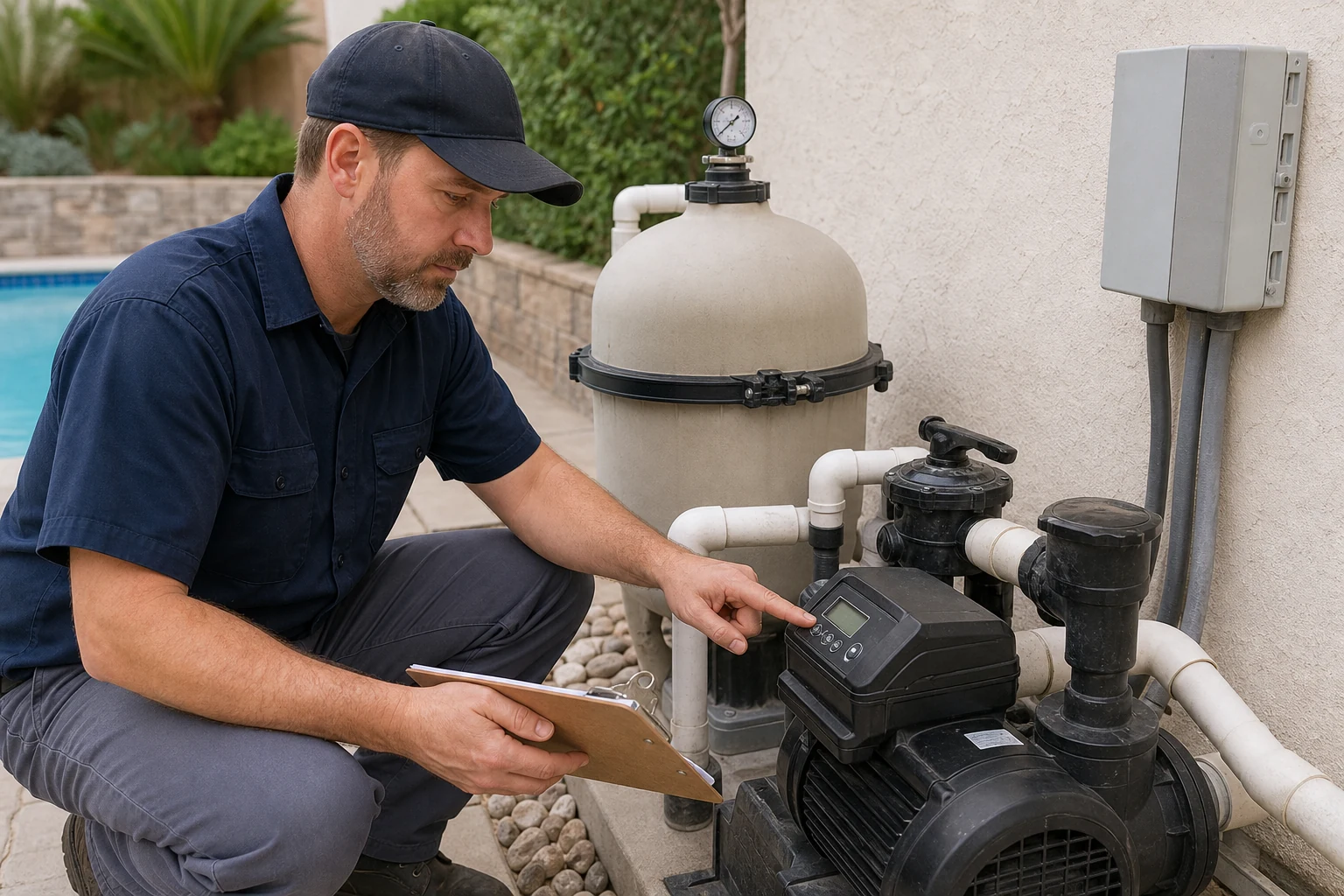
Final takeaway
Size the system, not just the pump. Define hydraulic modes, evaluate system head and component limits, choose an efficient pump whose curve covers those modes, and commission the lowest practical speed for each task. Qualified hydraulic and electrical work turns variable speed into real savings and dependable water care instead of an expensive guess.
Sources and Supporting Claims
U.S. Environmental Protection Agency ENERGY STAR
- Variable-speed pumps can match speed to filtration and higher-flow tasks.
- Lower pump speed can substantially reduce power demand.
- Pump choice must be paired with preventive maintenance and correct system operation.
U.S. Environmental Protection Agency WaterSense
Published 2022-09-01
- Pool filter types differ in particle capture, maintenance, and backwash water use.
- Cartridge filters do not require backwashing.
- Pool covers and equipment choices affect water and energy efficiency.
Pentair
- Filter disassembly and reassembly are safety-sensitive and model-specific.
- Poor clarity can reflect sanitizer, flow, sizing, media, or installation problems.
- The installed equipment manual controls service procedures.