How should cyanuric acid be managed in an outdoor residential pool?
Cyanuric acid slows sunlight-driven chlorine loss, but it also changes how quickly chlorine disinfects. Test it separately, account for stabilized chlorine products, and use dilution or water replacement only after confirming a high result and local water-disposal rules.
Cyanuric acid, often called stabilizer or conditioner, shields chlorine from rapid breakdown by ultraviolet sunlight. That benefit makes it useful in many outdoor pools. It also binds with chlorine and slows disinfection, so more is not automatically better. Homeowners should know which products add it, test it separately, and respond to verified buildup without unsafe draining.
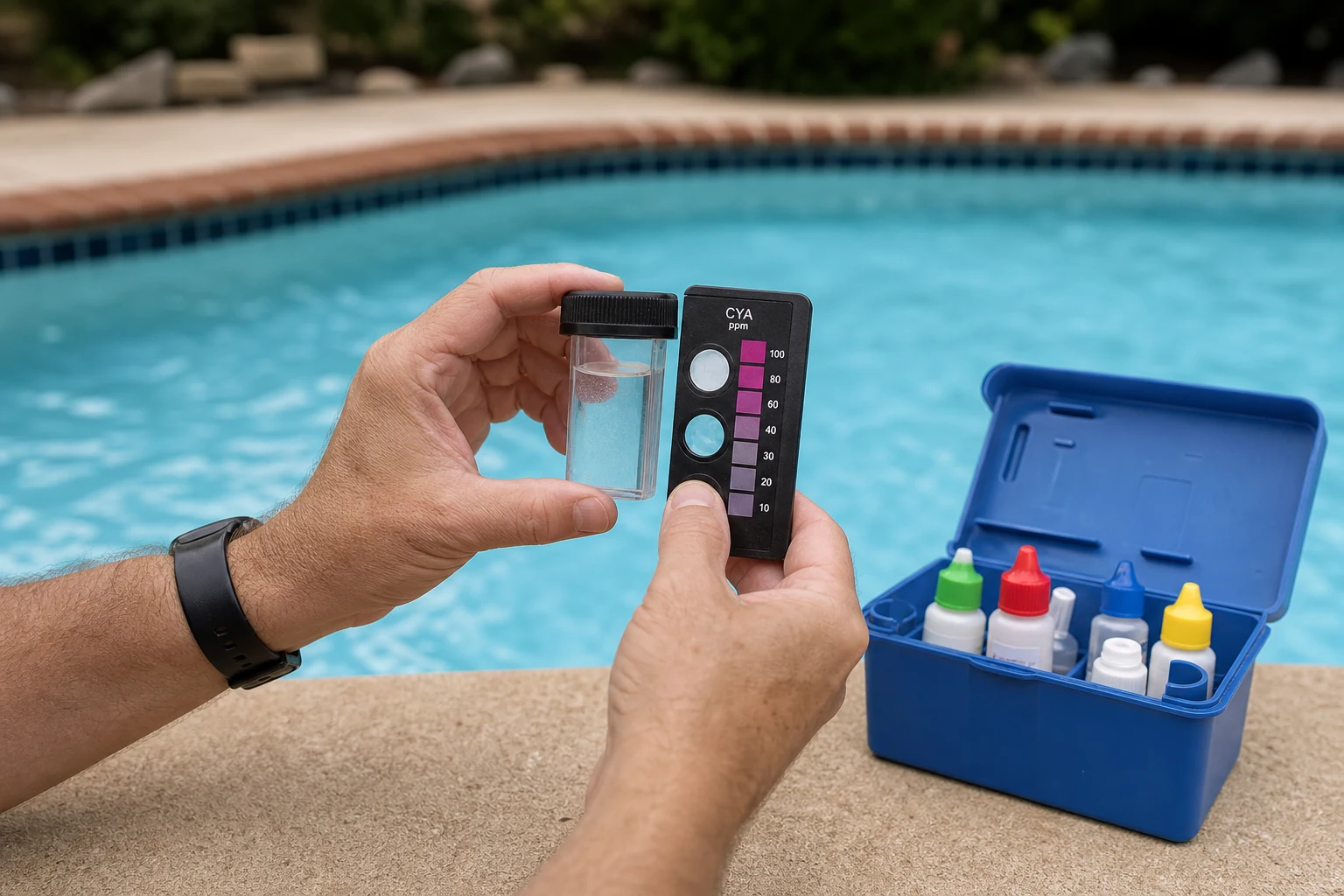
Understand what stabilizer does
Unstabilized chlorine can disappear quickly from a sunny outdoor pool. Cyanuric acid forms a reversible relationship with chlorine that reduces sunlight loss. The tradeoff is that the immediately active fraction is lower and some germs take longer to inactivate.
CDC home-pool guidance reflects this difference by recommending at least 2 ppm free chlorine when cyanuric acid or stabilized chlorine is used, compared with at least 1 ppm without it, while maintaining pH 7.0–7.8. These are health guidance minimums, not a universal treatment formula. Product labels, local rules, and the treatment system may require a different operating range or action level.
Identify every source of cyanuric acid
Pure stabilizer adds cyanuric acid directly. Dichlor and trichlor chlorine products also add it each time they are used. A tablet feeder can therefore increase stabilizer steadily even when the owner never buys a container labeled “cyanuric acid.”
Liquid sodium hypochlorite, calcium hypochlorite, and chlorine generated from salt do not add cyanuric acid by themselves. Switching sanitizer form changes other factors, so read the active ingredient and understand calcium, salt, and pH effects before changing.
Test with the method’s limits in mind
Many residential kits use a turbidity test: treated sample water becomes cloudy and obscures a marked dot. Bright indirect daylight, correct sample temperature, mixing time, viewing position, and clean glassware matter. The result is not highly precise; repeat the test and use the same technique.
Some tests have a low-end reporting floor and cannot quantify very high concentrations without a specified dilution. Do not invent a dilution ratio. Follow the kit procedure or obtain a laboratory or professional confirmation before replacing water.
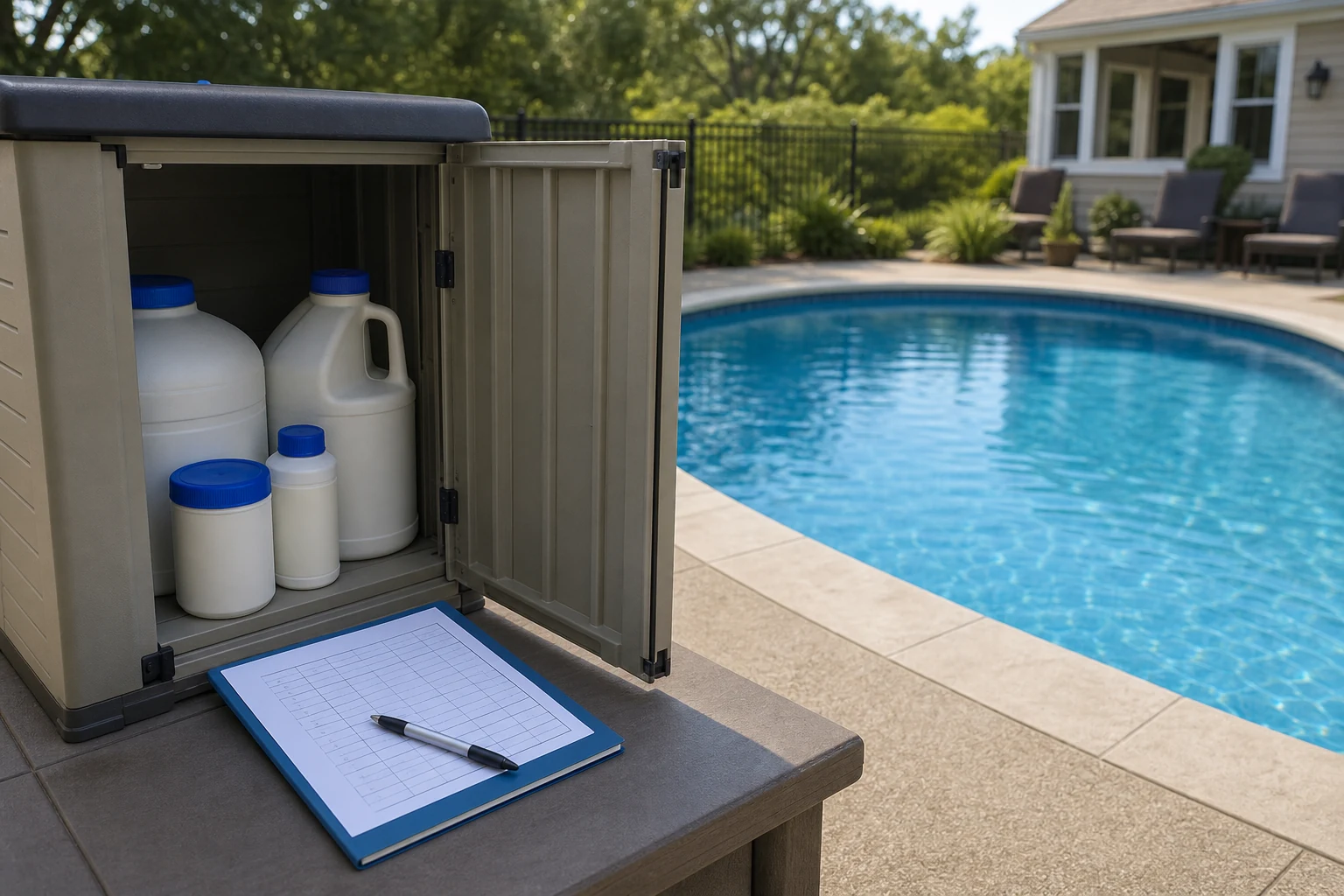
Record the result with free chlorine, pH, sanitizer products, water replacement, and date. Testing once and forgetting it allows stabilized products to build the level unnoticed.
Recognize the signs of excessive buildup
High cyanuric acid does not necessarily make water look cloudy or green. The common pattern is a pool that needs a higher chlorine residual to maintain equivalent control, or one that repeatedly develops algae despite apparently “normal” chlorine according to a generic chart.
Do not respond by adding random algaecides or ever-larger shock doses without testing. Confirm circulation, filtration, brushing, pH, free and combined chlorine, and the cyanuric acid result. A treatment plan must account for the relationship rather than one number.
Lowering cyanuric acid usually means removing water
Cyanuric acid does not evaporate with water. When water evaporates, the stabilizer remains and can become more concentrated. Splash-out, backwashing, leaks, and intentional replacement remove some.
For a confirmed excessive level, partial replacement with lower-cyanuric-acid water is the common direct remedy. Calculate a staged plan, verify fill-water chemistry, and comply with drought and discharge rules. Avoid draining an inground pool without considering groundwater and structural risk. A pool professional can recommend staged exchange or specialized treatment where available.
Products marketed as cyanuric-acid reducers should be evaluated by label, evidence, limits, and compatibility. Do not assume they eliminate the need for verification.
Avoid the “more protection” trap
Adding stabilizer above the range appropriate for the system does not keep improving sunlight protection indefinitely. It increases management complexity and can make recovery from contamination or algae slower. Indoor pools generally do not benefit from ultraviolet protection, and many public-pool rules restrict or prohibit its use indoors.
Saltwater pools may still use a controlled cyanuric acid level outdoors because generated chlorine is also vulnerable to sunlight. Follow the generator manual and verify the result independently rather than trusting a controller that does not measure stabilizer.
Build a sustainable sanitizer plan
Estimate how much cyanuric acid the current chlorine products add over a season. Test after major water replacement and during long periods of stabilized-product use. If the number trends upward, adjust the product strategy before it becomes a major dilution project.
Maintain secure chemical storage. Never mix stabilized chlorine with another chlorine product, acid, or unknown residue. Use the original container, a dedicated dry feeder approved for the product, and label-directed protective equipment.
Final takeaway
Cyanuric acid is useful sunlight protection with a real tradeoff. Know which products add it, test with a repeatable method, interpret free chlorine in context, and prevent accumulation through a deliberate sanitizer plan. If a verified level is excessive, controlled water replacement—not guesswork—is usually the shortest honest path.
Sources and Supporting Claims
Centers for Disease Control and Prevention
Published 2024-05-10
- Residential pools need routine free-chlorine and pH testing.
- CDC recommends pH 7.0 to 7.8 and provides minimum free-chlorine guidance.
- DPD kits are more accurate than strips and product directions control use.
National Pesticide Information Center at Oregon State University
- Pool antimicrobial products control bacteria, algae, and viruses.
- Chemical labels and first-aid directions control safe handling.
- Cyanuric acid slows chlorine breakdown in sunlight.
Maryland Department of Health via Cornell Legal Information Institute
- pH, alkalinity, calcium hardness, temperature, and saturation balance interact.
- Public-pool limits illustrate why hardness cannot be evaluated in isolation.
- Residential owners must still follow product, surface, and local guidance rather than treating a public code as a universal home-pool rule.