How should homeowners test residential pool water and interpret the results?
Collect a representative sample away from returns and chemical feeders, follow the test manufacturer's timing and range, and record free chlorine and pH along with other balance factors. Recheck surprising results before dosing, because sampling error, expired reagents, and very high chlorine can distort readings.
Pool testing is a measurement process, not a color-matching ritual before adding products. Collect a representative sample, use fresh reagents and the method’s exact timing, record free chlorine and pH, and verify surprising results before treatment. A good log shows trends; one isolated reading rarely explains why water changed.
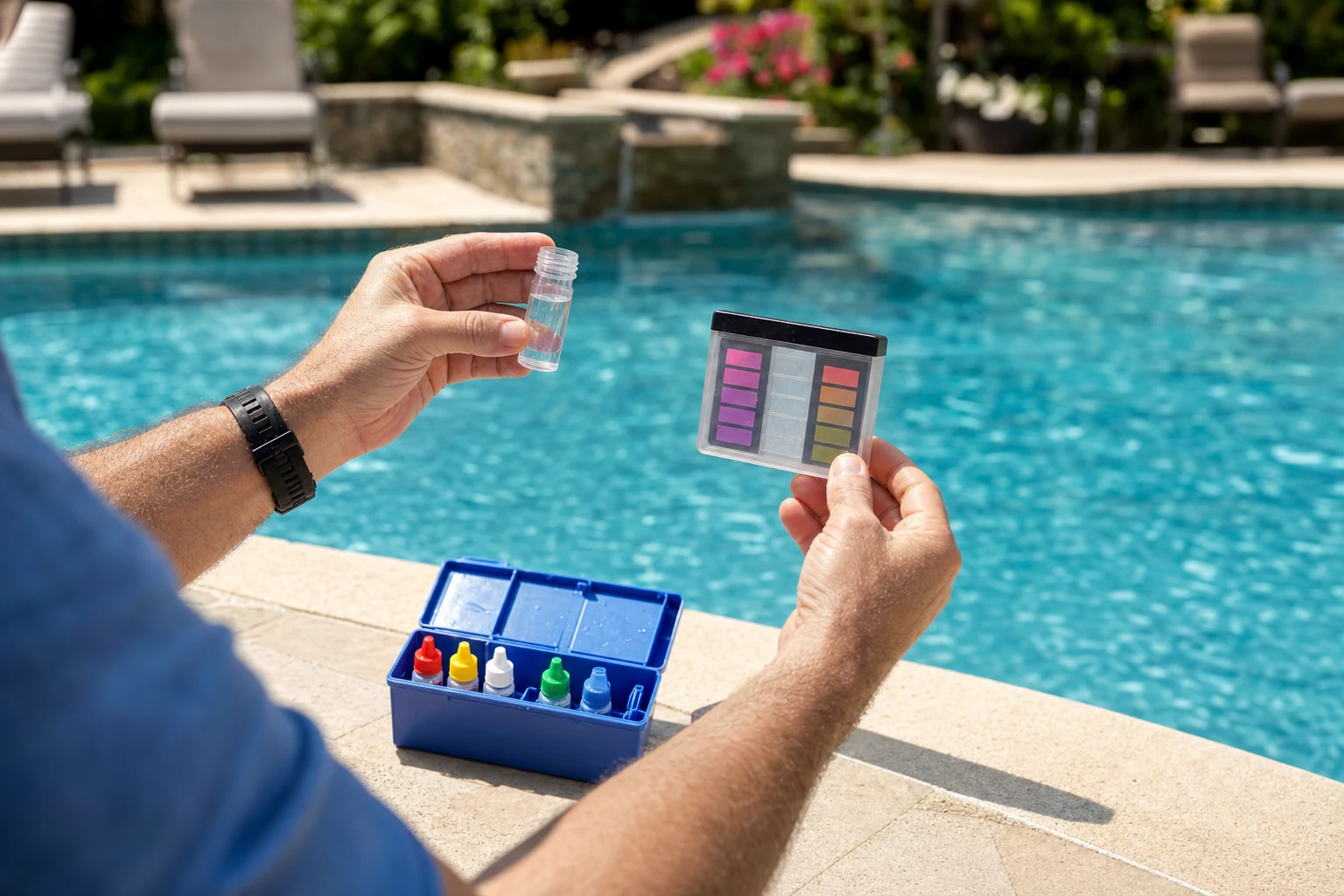
Choose a method you can use correctly
Test strips are quick and useful for screening, but their color blocks can be difficult to read and their resolution is limited. Liquid drop-count kits can measure common balance parameters with more detail. CDC recommends a DPD method for more accurate chlorine and pH testing and notes that strips are generally less accurate. Digital readers can reduce visual interpretation, but they still depend on clean cells, calibration, fresh reagents, and correct technique.
Select a kit that covers the pool’s sanitizer and treatment system. A basic chlorine pool needs free and total chlorine plus pH. Total alkalinity, calcium hardness, and cyanuric acid are also important for many outdoor pools. A saltwater chlorine generator needs an independently verified salt test appropriate to the model. Never use a drinking-water meter as a substitute for parameters it was not designed to measure.
Protect reagents and equipment
Heat, sunlight, moisture, and age can ruin reagents. Store the kit closed in a cool, dry place away from pool chemicals. Check expiration guidance, replace stained or cloudy bottles, and do not swap caps or droppers. Rinse test cells with pool water before sampling and with clean water after testing.
Wash and dry your hands. Do not perform a test on a chemical-stained workbench or use a kitchen cup that may contain detergent. Keep the kit and sample away from children and pets.
Collect a representative sample
Sample away from a return jet, skimmer, chemical feeder, spillway, or recently treated spot. Reach below the immediate surface with the opening facing down, then turn it to fill at roughly elbow depth. Use the same general location and time for trend comparisons.
Wait for a labeled treatment to circulate as directed before retesting. Testing directly after adding chlorine or acid can produce a local reading that does not represent the pool. Heavy rain, a party, a cover removal, or a long pump outage should be noted in the log because each can change interpretation.
Measure free and combined chlorine
Free chlorine is the portion available for disinfection. Total chlorine includes free chlorine plus combined forms; subtracting free from total gives an estimate of combined chlorine within the method’s precision. Follow the kit’s order, fill line, drop size, mixing, and reading window.
CDC home-pool guidance recommends at least 1 part per million free chlorine in pools without cyanuric acid and at least 2 ppm when cyanuric acid or stabilized chlorine is used, with pH between 7.0 and 7.8. Product labels and local requirements may call for different operating ranges or upper limits. Do not turn a minimum public-health recommendation into an automatic dose target without considering the treatment system and label.
Very high chlorine can bleach some DPD tests and appear falsely low or even zero. If the water smells harsh, a feeder has malfunctioned, or a large dose was recently added, treat an implausible zero as a reason to verify—not permission to add more.
Read pH with chlorine in context
pH affects sanitizer performance, swimmer comfort, surfaces, and equipment. Compare the sample under neutral daylight against a white background if the kit relies on color. Sunglasses, colored patio umbrellas, warm indoor lighting, or an old comparator block can distort the result.
CDC’s 7.0–7.8 guidance balances disinfection, comfort, and equipment considerations. A single pH adjustment may not hold if total alkalinity, aeration, fill water, a salt system, or frequent acid addition is driving a trend. Record the pattern before repeatedly correcting the symptom.
Test supporting balance factors
Total alkalinity helps describe resistance to pH change. Calcium hardness contributes to scale or aggressive-water risk, especially in plaster and cementitious finishes. Cyanuric acid protects outdoor-pool chlorine from sunlight but changes chlorine behavior and can accumulate when stabilized products are used.
These numbers interact. Do not diagnose scale from calcium alone or corrosive water from pH alone. Use the pool surface manufacturer’s guidance and a recognized saturation-balance method when appropriate. Public-pool codes can offer context but are not universal residential instructions.
Turn a reading into a controlled action
First ask whether the result is credible. Repeat the sample, check reagent age, and compare with a second method or a qualified pool lab if the decision is significant. Then calculate the treatment for actual pool volume and use only a product whose label addresses the measured condition.
Make one adjustment at a time, circulate, and retest. Never mix chemicals or pour water into a chemical container. If water is cloudy enough that the bottom cannot be seen, keep swimmers out even when the numeric readings look acceptable.
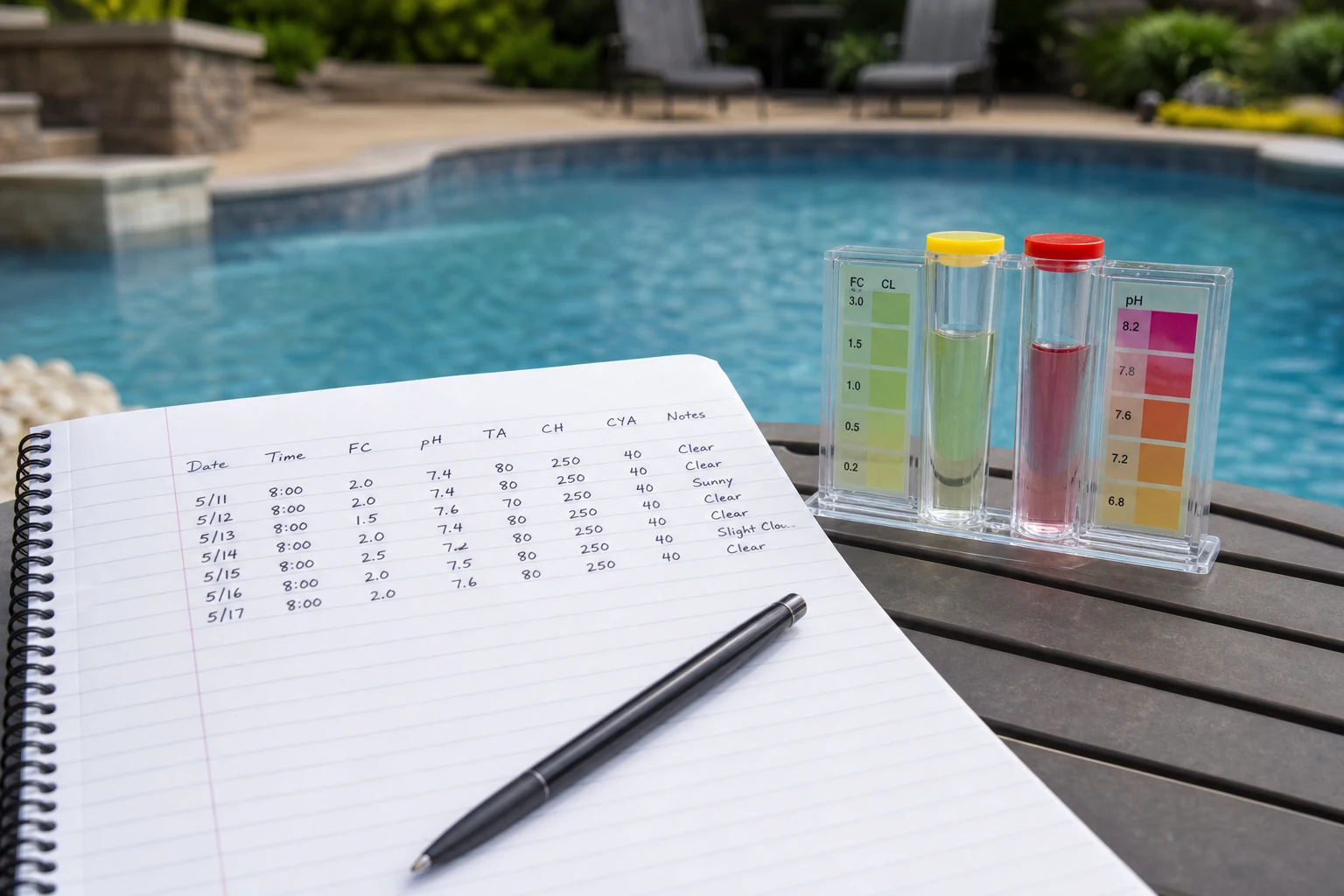
Final takeaway
Reliable testing comes from repeatable sampling, sound reagents, correct timing, and written records. Measure free chlorine and pH together, add supporting parameters as the pool requires, and verify unusual results before dosing. The goal is not to chase a perfect color block; it is to make fewer, better-supported decisions.
Sources and Supporting Claims
Centers for Disease Control and Prevention
Published 2024-05-10
- Residential pools need routine free-chlorine and pH testing.
- CDC recommends pH 7.0 to 7.8 and provides minimum free-chlorine guidance.
- DPD kits are more accurate than strips and product directions control use.
National Pesticide Information Center at Oregon State University
- Pool antimicrobial products control bacteria, algae, and viruses.
- Chemical labels and first-aid directions control safe handling.
- Cyanuric acid slows chlorine breakdown in sunlight.