Why does calcium hardness matter in a residential pool?
Calcium hardness should be evaluated with pH, alkalinity, temperature, dissolved solids, and the pool surface. High scale risk and low corrosive-water risk cannot be diagnosed safely from one hardness number alone.
Calcium hardness measures dissolved calcium in pool water, usually reported as parts per million calcium carbonate. It matters because water with a strong tendency to deposit minerals can form scale, while water that is undersaturated can contribute to damage of cement-based surfaces and metal components. The hardness value cannot be interpreted safely by itself.
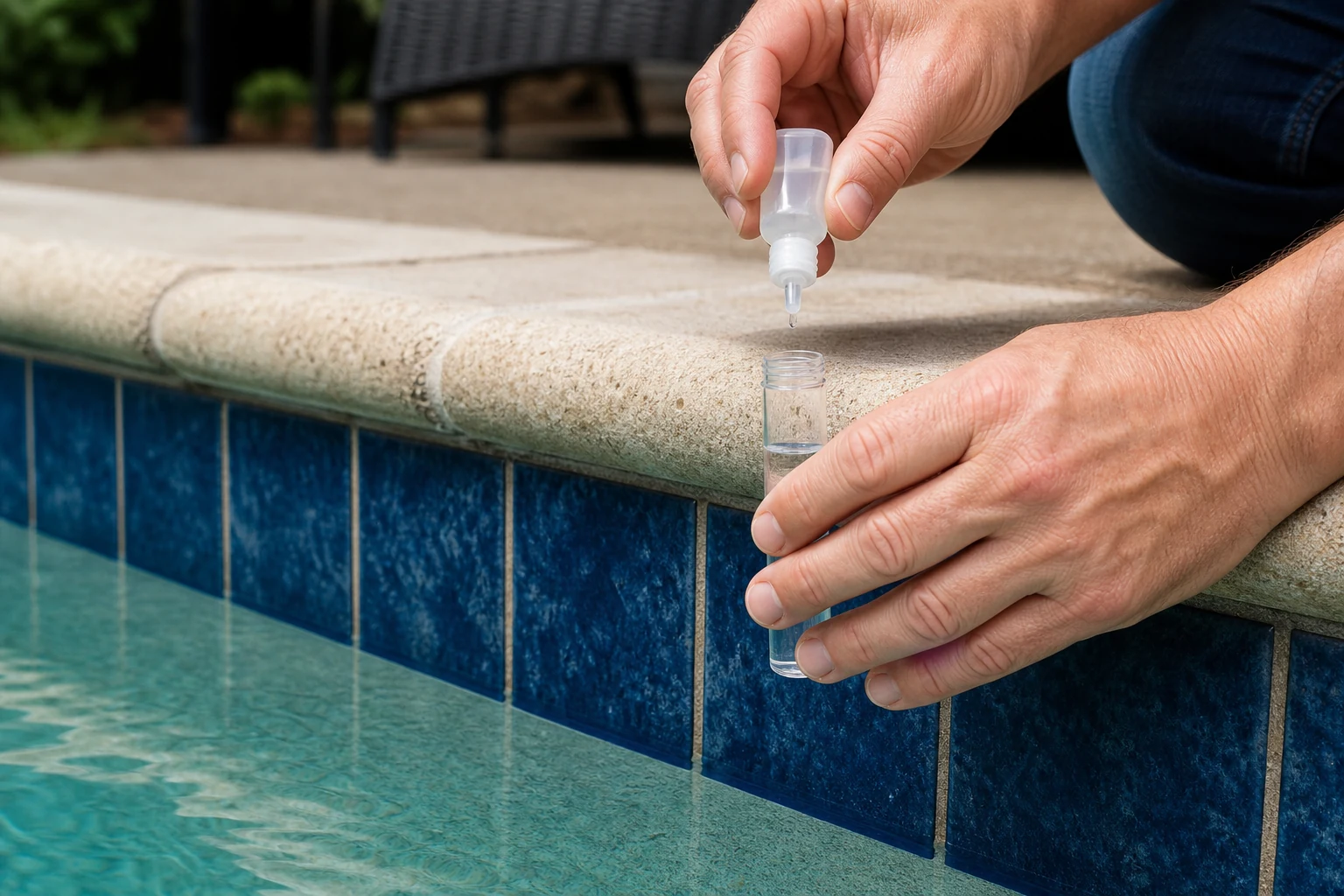
Separate hardness from alkalinity
Calcium hardness describes calcium concentration. Total alkalinity describes acid-neutralizing capacity. Both are reported in calcium-carbonate equivalents, which is one reason they are confused, but they answer different questions.
A pool can have high alkalinity and moderate calcium, low alkalinity and high calcium, or any other combination. Correcting the wrong parameter can worsen scale or pH control. Use separate tests and record both.
Look for patterns, not a single white mark
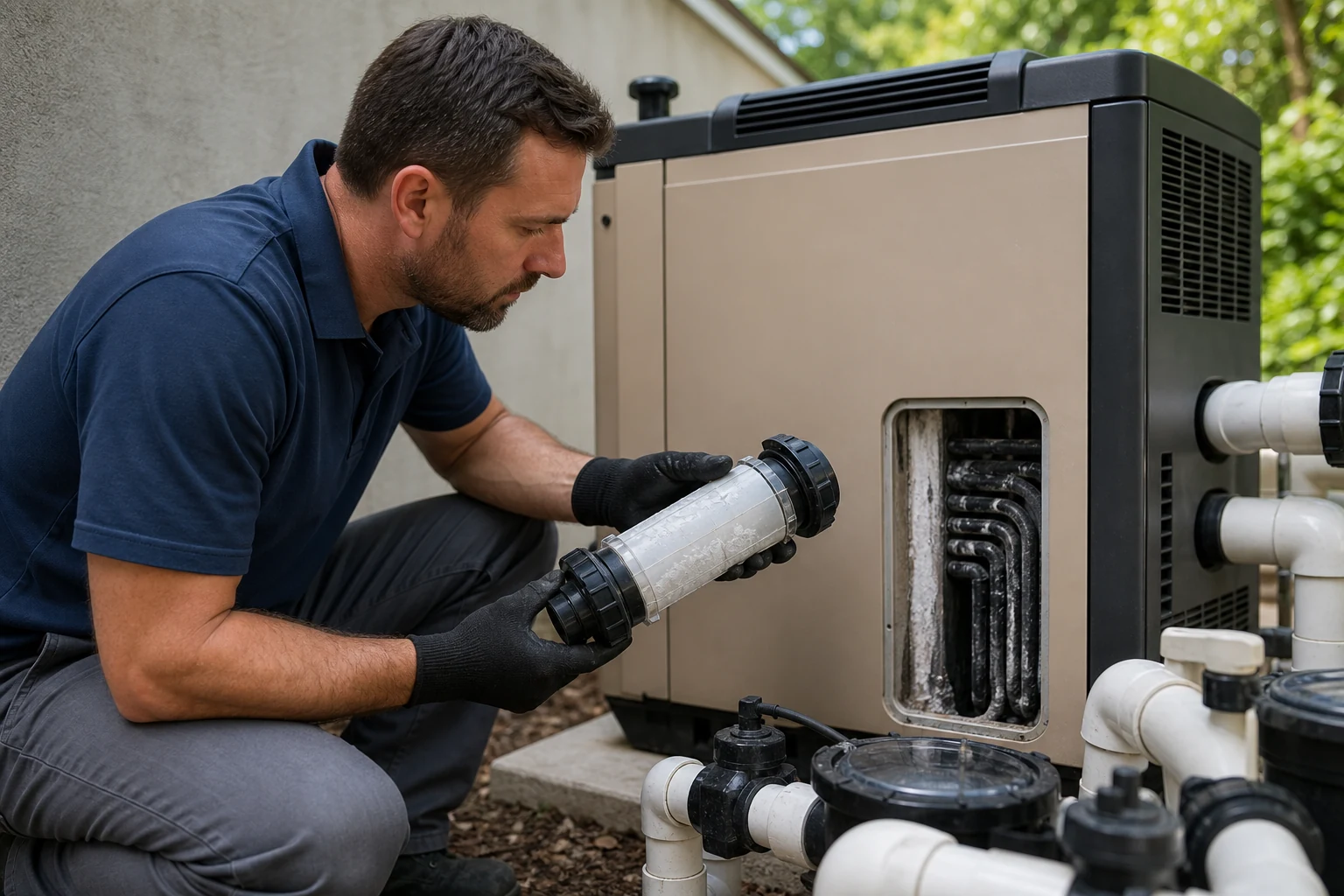
Scale often appears as rough, light-colored deposits at the waterline, on spillways, salt cells, heaters, or tile. It may also cloud water when a rapid pH rise causes calcium carbonate to precipitate. But not every white deposit is calcium scale; salt residue, grout, efflorescence, or cleaning products can look similar.
Low-saturation water may contribute to etching, pitting, rough plaster, grout loss, or metal corrosion. Those symptoms also have structural, application, electrical, or chemical causes. Do not diagnose an expensive surface problem from one test or photograph.
Interpret hardness with the full balance
pH, total alkalinity, water temperature, calcium hardness, and dissolved solids interact. Public-pool rules such as Maryland’s illustrate the use of a saturation index to combine these variables, but their numeric limits are not automatically the operating rules for every residential pool.
Warmer water and higher pH generally increase scale tendency. A heater or salt cell can develop localized high-temperature or high-pH conditions even when the bulk pool looks acceptable. Plaster pools need enough calcium balance to protect cementitious material; vinyl and fiberglass pools do not have the same surface demand but their heaters, metals, tile, and grout still matter.
Consult the pool finish, heater, and salt-system manufacturers for permitted ranges. Use one consistent, recognized saturation method rather than switching calculators whenever a result is inconvenient.
Confirm the test
Hardness titrations require correct sample size, mixing, and endpoint recognition. Metals in the water can interfere with some tests. Very high hardness may need a smaller sample or dilution procedure specified by the kit. Test fill water too, because every top-up can move the pool in the same direction.
If the result would lead to partial draining or a large chemical addition, confirm it with fresh reagents or a qualified laboratory. Record the method and units. “Total hardness” from a drinking-water strip may include magnesium and is not always equivalent to the calcium-hardness value used in pool balance.
Respond to high hardness carefully
There is no common pool chemical that simply removes a large amount of dissolved calcium. Controlled dilution with lower-calcium water is the direct method, but water availability, drought restrictions, groundwater, pool structure, salt, cyanuric acid, and discharge rules can limit it. Reverse-osmosis pool services exist in some markets, but availability and economics vary.
Before replacing water, reduce avoidable scale pressure. Keep pH and alkalinity in an appropriate, stable range, manage temperature, and avoid adding calcium-containing products when they are not needed. A sequestrant may help manage certain minerals but does not make the calcium disappear and must be maintained according to its label.
Never drain an inground pool without evaluating groundwater and structural risk. A qualified pool professional can plan staged replacement or other treatment.
Respond to low hardness based on surface
If confirmed hardness is too low for a cementitious finish and the overall balance is undersaturated, a labeled calcium-hardness increaser may be appropriate. Calculate the dose for the actual volume, divide a large correction into stages, and follow the label’s application and protective-equipment directions.
Calcium chloride releases heat as it dissolves. Do not mix it with other products or improvise a concentrated slurry in a container not approved by the label. Brush any settled material as directed and retest after circulation.
For vinyl or fiberglass, do not add calcium merely to match a plaster-pool chart. The equipment and warranty may establish a minimum, but unnecessary calcium can increase future scale pressure.
Prevent repeat problems
Test fill water seasonally and after a source change. Track water replacement, evaporation, calcium-containing chlorine products, pH trend, heater use, and salt-cell cleaning. Evaporation leaves calcium behind, so repeated top-ups can raise concentration even when no calcium product is added.
Use a cover to reduce evaporation when practical. Maintain filtration and circulation, but recognize that a standard filter does not remove dissolved calcium.
Final takeaway
Calcium hardness is one part of water balance, not a standalone pass/fail number. Confirm the test, consider pH, alkalinity, temperature, dissolved solids, surface, and equipment, then choose a controlled response. Preventing scale and aggressive water is mainly about managing the whole system before deposits or damage become visible.
Sources and Supporting Claims
Maryland Department of Health via Cornell Legal Information Institute
- pH, alkalinity, calcium hardness, temperature, and saturation balance interact.
- Public-pool limits illustrate why hardness cannot be evaluated in isolation.
- Residential owners must still follow product, surface, and local guidance rather than treating a public code as a universal home-pool rule.
University of Florida IFAS Extension
- Alkalinity measures acid-neutralizing capacity and is commonly reported as calcium-carbonate equivalent.
- Hardness and alkalinity are related but distinct water properties.
Centers for Disease Control and Prevention
Published 2024-05-10
- Residential pools need routine free-chlorine and pH testing.
- CDC recommends pH 7.0 to 7.8 and provides minimum free-chlorine guidance.
- DPD kits are more accurate than strips and product directions control use.