How do pool fences, covers, alarms, and door controls contribute to safety?
A four-sided isolation fence controls access continuously, a self-closing gate protects the opening, door controls address house-to-pool access, alarms provide warning, and a compliant safety cover adds another layer. Every component needs correct installation, routine testing, and local-code review.
Residential pool barriers do different jobs. A fence and gate control access continuously, door controls address the route from the house, a safety cover closes the water surface, and alarms warn that a boundary or water has been entered. They work best together and must be installed, tested, and maintained under local rules.
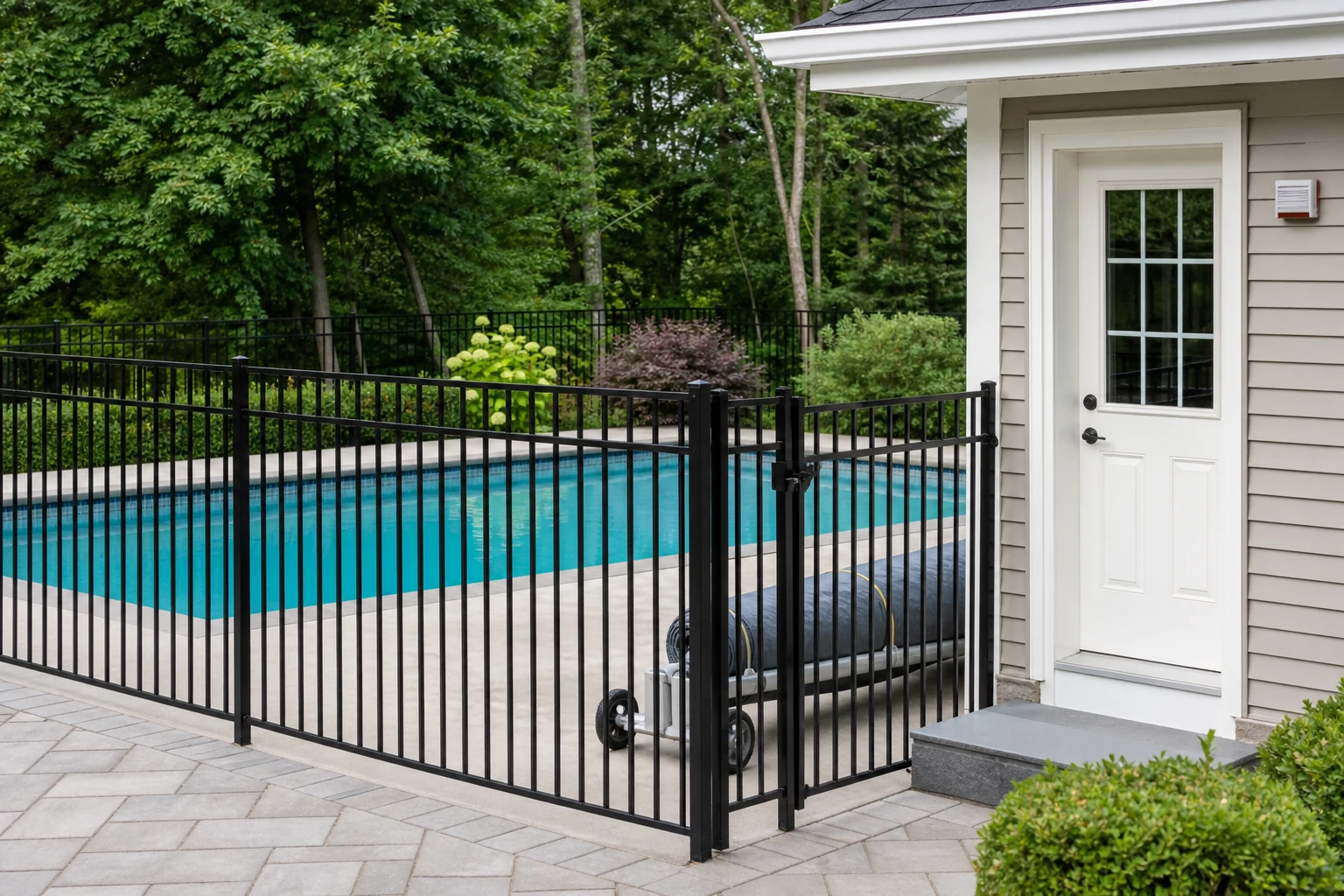
Four-sided isolation fences
CPSC guidance emphasizes barriers designed to keep a child from getting over, under, or through them. A four-sided isolation fence separates the pool from the home and yard, so a child can play outside without direct access to water.
Exact height, opening size, horizontal-member placement, ground clearance, and setback vary by code and design. A fence that meets a property-boundary rule may not meet a pool-isolation rule. Have the plan reviewed by the local building authority.
Inspect for corrosion, loose panels, erosion under the fence, vegetation, stacked materials, or furniture that makes it climbable. A beautiful fence is not protective if landscaping creates steps.
Self-closing and self-latching gates
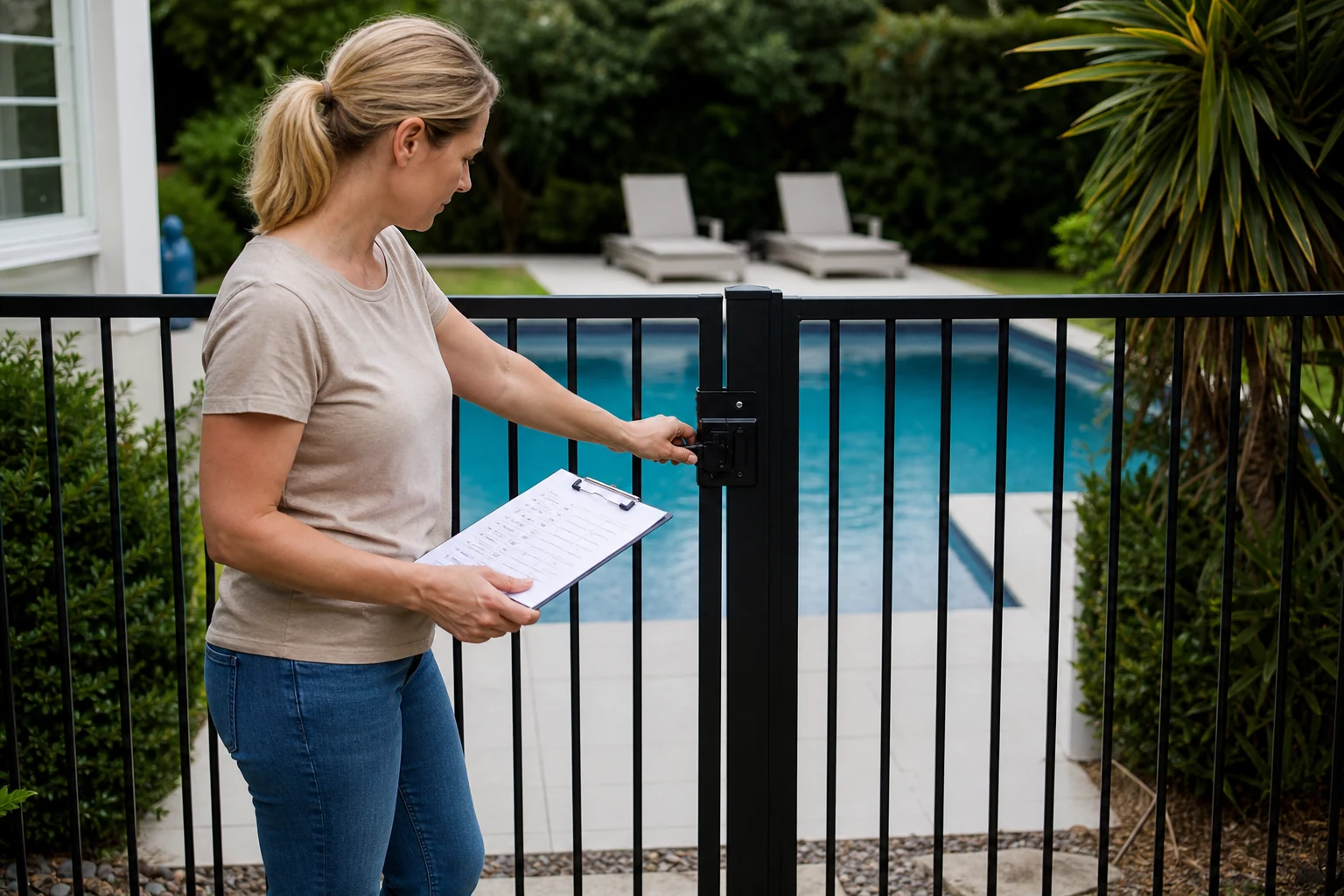
A gate should return to the closed, latched position without a push. Test from fully open and from only a few inches open. Settlement, hinge wear, wind, snow, or a dragged hose can stop it.
Latch location, opening direction, locks, and gate width are code-sensitive. Keep the latch protected from child manipulation and never use a rock or hook to hold the gate open. Service workers need a controlled access plan.
House doors and windows
If a door or window opens toward the pool area, locks and alarms can add protection. The alarm should be distinct, audible where caregivers are located, and reset in a way that does not encourage permanent bypass. Battery alerts and test frequency matter.
A screen is not usually a barrier. Sliding doors can be left partly open. Pet doors may create an unrecognized opening. Consider every route from sleeping areas, garage, side yard, and rental suite.
Where practical, a four-sided fence reduces reliance on perfect door behavior.
Safety covers
A safety cover is engineered, installed, and maintained to meet a defined protective function. Mesh, solid anchored, and automatic systems manage water and loads differently. Confirm the standard, warranty, anchors, gaps, drainage, and operating procedure.
A floating bubble or solar cover is not a safety cover. It can hide the water surface and entangle a person who falls onto it. Never advertise or treat it as child protection.
Remove standing water, repair damaged fabric or tracks, and keep controls inaccessible to children. An automatic cover left open provides no barrier.
Gate, door, and pool alarms
Gate and door alarms signal an opening. Pool alarms may detect surface movement, underwater disturbance, or a person entering. Wearable alarms depend on the device being worn and maintained.
Compare detection limits, pool size, wind and rain behavior, pets, water features, installation, battery, volume, remote alerts, and test procedure. False alarms can cause users to disable a device, while a missed alarm can create false confidence.
An alarm is a notification layer. It does not stop access, replace supervision, or guarantee rescue time.
Above-ground and portable pools
Walls can form part of a barrier only when height, structure, access, and local code support that role. Ladders and steps may need to be removed, locked, or enclosed when the pool is not supervised. Nearby furniture can defeat the wall.
Portable pools deserve the same seriousness. A small depth can drown a child. Drain and store a truly portable pool when practical, or provide a compliant barrier and controlled access.
Integration and human behavior
Choose components that are easy enough to use every time. A heavy manual cover that no one closes, a gate that latches only when slammed, or an alarm silenced during parties is not a reliable layer.
Write a closing checklist: swimmers out, toys removed, cover closed if used, gate tested, doors secured, alarms active, and children accounted for. Give guests and service workers one rule—never prop the barrier open.
Verify codes and insurance
Local building, fire, health, zoning, and electrical rules can overlap. Homeowners associations may add design requirements but do not replace government code. An insurer may require specific barriers, alarms, or covers.
Get permits and inspections, retain product documentation, and tell the insurer about the pool and safety equipment. Recheck after renovations, fence replacement, or adding a spa.
Final takeaway
Use a fence to isolate, a self-latching gate to protect the opening, door controls to manage house access, a real safety cover to close the surface, and alarms to warn. Each has failure modes. Local compliance, daily testing, and active supervision turn separate products into a functioning protection system.
Sources and Supporting Claims
U.S. Consumer Product Safety Commission
- Residential pool barriers include fences, self-closing gates, door alarms, and safety covers.
- Barrier design should prevent a child from getting over, under, or through it.
- Local codes may impose additional requirements.
Pool Safely, U.S. Consumer Product Safety Commission
Published 2017-03-01
- Fences, self-closing gates, covers, and alarms are complementary layers.
- No barrier device replaces active supervision.
American Red Cross
- Home-pool safety uses barriers, a designated water watcher, close supervision, water competency, and emergency preparation.
- CPR and water-rescue skills should be learned through appropriate training.
- Swim sober and keep swimmers away from drains.