How do pH and total alkalinity interact in pool water?
pH describes current acidity or basicity, while total alkalinity describes much of the water's resistance to pH change. Diagnose both together, make small label-directed adjustments, circulate, and retest instead of chasing pH with repeated large doses.
pH and total alkalinity are related, but they are not the same measurement. pH describes how acidic or basic the water is at the moment. Total alkalinity describes much of the water’s capacity to neutralize added acid and resist sudden pH change. Understanding the difference prevents the familiar cycle of adding acid one day, increaser the next, and never resolving the underlying trend.
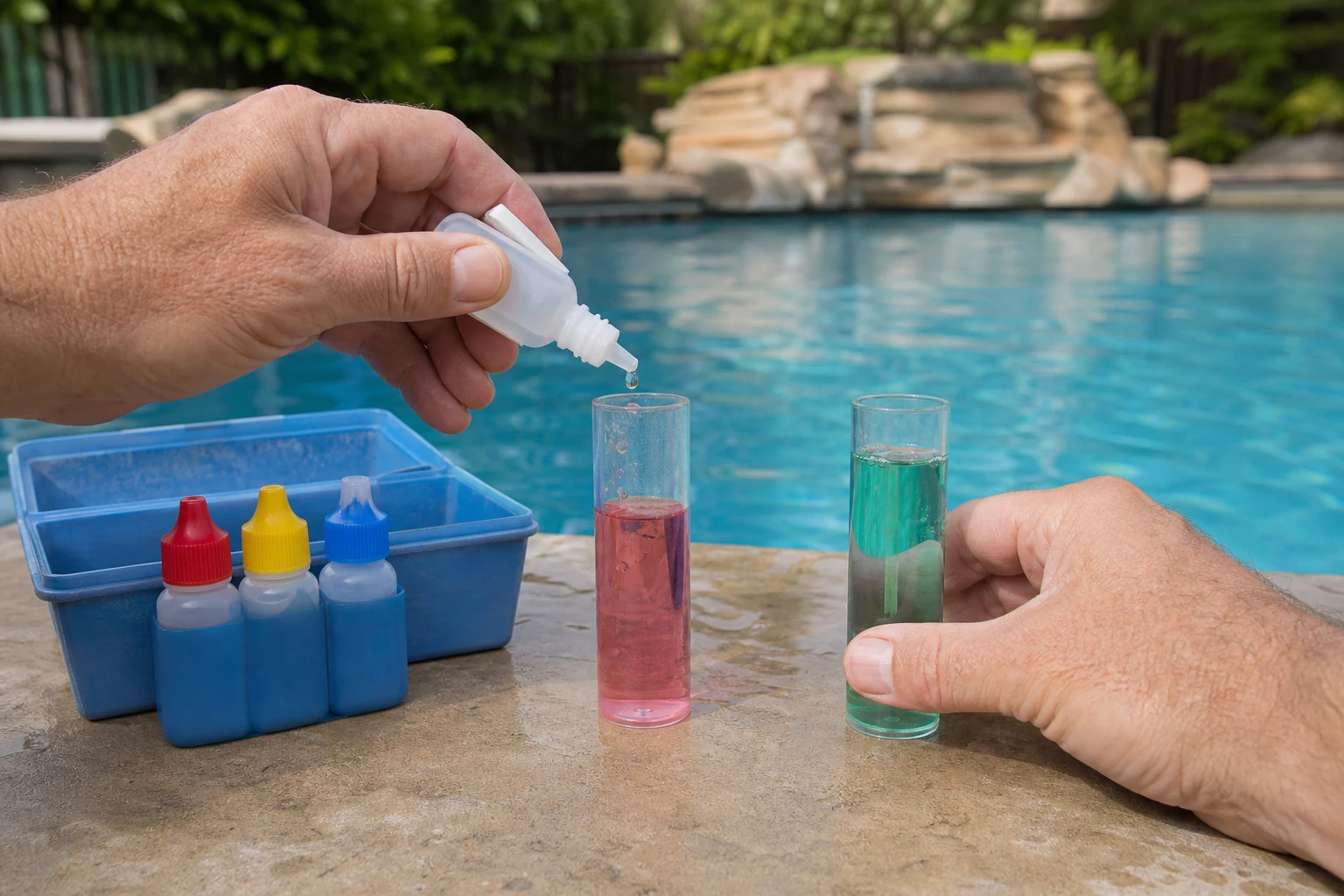
pH is a current condition
The pH scale is logarithmic, so a small numeric change represents a meaningful chemical change. In a pool, pH affects the balance between chlorine species, swimmer comfort, metal corrosion, mineral scale, and the behavior of some surfaces.
CDC recommends pH 7.0–7.8 for home pools. It explains that chlorine becomes less effective at killing germs as pH rises, especially above 8.0, while water below 7.0 can increase corrosion risk. A surface manufacturer or treatment system may specify a narrower operating range.
Test pH with a method that is valid for the current sanitizer level. Some indicators are distorted by unusually high chlorine. Confirm a surprising reading before adding a corrective product.
Total alkalinity is the buffer
Alkalinity is commonly reported as parts per million equivalent calcium carbonate. It represents acid-neutralizing capacity, not simply “how alkaline” the water feels. Carbonate and bicarbonate species provide much of the buffer in typical pool water.
When total alkalinity is too low for the system, pH can move quickly and become difficult to control. When it is higher than the pool needs, pH may drift upward persistently and acid demand can increase. The useful target depends on sanitizer type, aeration, fill water, plaster or other surfaces, and the chosen balance method.
Carbon dioxide explains much pH rise
Pool water contains dissolved carbon dioxide in equilibrium with the air. Aeration from spillways, spas, fountains, returns aimed at the surface, swimmers, and negative-edge features can drive carbon dioxide out. As carbon dioxide leaves, pH rises while total alkalinity changes much more slowly.
This is why repeatedly adding acid without considering aeration and alkalinity may produce a sawtooth pattern. Acid lowers pH and also consumes alkalinity; aeration then raises pH again. The long-term fix may involve a more appropriate alkalinity level or less unnecessary aeration, not a larger acid dose.
Adjust in a deliberate order
Start with verified tests of pH and total alkalinity. Review recent additions, fill-water values, rain, use of an acidic stabilized tablet, operation of a saltwater chlorine generator, and aerating features. Decide whether the issue is one abnormal reading or a repeated trend.
If alkalinity is outside the range appropriate for the system, adjust it in controlled steps using a labeled product. Sodium bicarbonate primarily raises total alkalinity, although it can influence pH. Products sold as pH increaser may contain sodium carbonate and can raise both pH and alkalinity more strongly. Acid lowers pH and alkalinity.
Calculate doses using actual pool volume. Add only as the label directs, maintain required circulation, and retest after the stated interval. Do not add acid and alkaline products together or stage open containers near each other.
Avoid generic correction charts
Public-pool codes and industry tables offer useful context, but residential pools differ. A vinyl pool, a new plaster startup, an uncovered salt pool with a spillway, and a covered indoor pool can have different stable conditions. Product concentration also varies.
Do not use an online calculator without checking its assumptions, units, and product strength. Gallons versus liters, dry acid versus liquid acid, and percent concentration can turn a plausible number into a dangerous overdose. When the volume is uncertain, measure the pool carefully and use conservative increments.
Evaluate pH within total water balance
Scale or etching risk is not controlled by pH and alkalinity alone. Calcium hardness, water temperature, dissolved solids, and surface type contribute. A saturation index can help organize these variables, but it is a model, not permission to ignore sanitizer, manufacturer limits, or visible symptoms.
New cementitious surfaces may have special startup chemistry and brushing requirements. Follow the builder or finish manufacturer rather than applying a generic mature-pool target. If fill water has unusual alkalinity or hardness, periodic partial replacement may change more than one variable at once.
Build a useful log
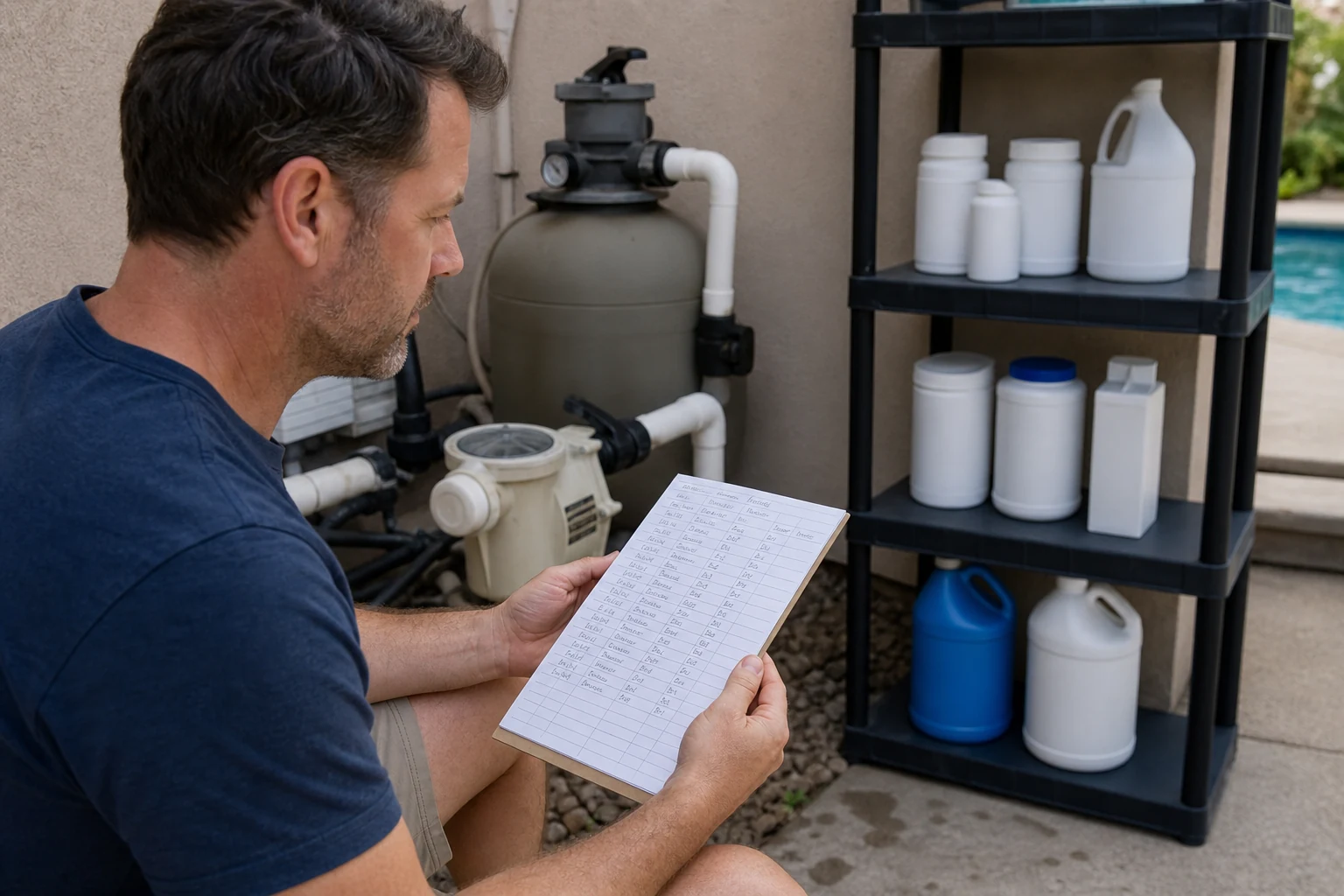
Record pH and alkalinity along with sanitizer, water temperature, major chemical additions, and operation of aerating features. Note the pH rise per day or week rather than only the endpoints. A pattern can reveal an oversized acid feeder, a miscalibrated probe, fresh plaster demand, or a salt system that needs a different control strategy.
Final takeaway
pH is the current condition; total alkalinity is much of the buffer that controls how that condition changes. Test both, diagnose the trend, consider aeration and the treatment system, and adjust in small label-directed steps. Stable water comes from managing the relationship, not forcing one number up and down.
Sources and Supporting Claims
Centers for Disease Control and Prevention
Published 2024-05-10
- Residential pools need routine free-chlorine and pH testing.
- CDC recommends pH 7.0 to 7.8 and provides minimum free-chlorine guidance.
- DPD kits are more accurate than strips and product directions control use.
University of Florida IFAS Extension
- Alkalinity measures acid-neutralizing capacity and is commonly reported as calcium-carbonate equivalent.
- Hardness and alkalinity are related but distinct water properties.
Maryland Department of Health via Cornell Legal Information Institute
- pH, alkalinity, calcium hardness, temperature, and saturation balance interact.
- Public-pool limits illustrate why hardness cannot be evaluated in isolation.
- Residential owners must still follow product, surface, and local guidance rather than treating a public code as a universal home-pool rule.