How can homeowners prevent pool algae and respond when it appears?
Prevent algae by maintaining disinfectant, circulation, filtration, and routine brushing. When growth appears, confirm water tests and equipment operation, brush affected surfaces, use only label-directed treatment, filter out debris, and keep swimmers out until clarity and chemistry are restored.
Algae prevention is mostly ordinary pool operation done consistently: maintain an appropriate disinfectant residual, keep pH in range, circulate and filter effectively, brush low-flow surfaces, and remove debris. When algae appears, diagnose why those defenses failed before buying a shelf of treatments. The pool stays closed until the bottom is visible and chemistry is restored.
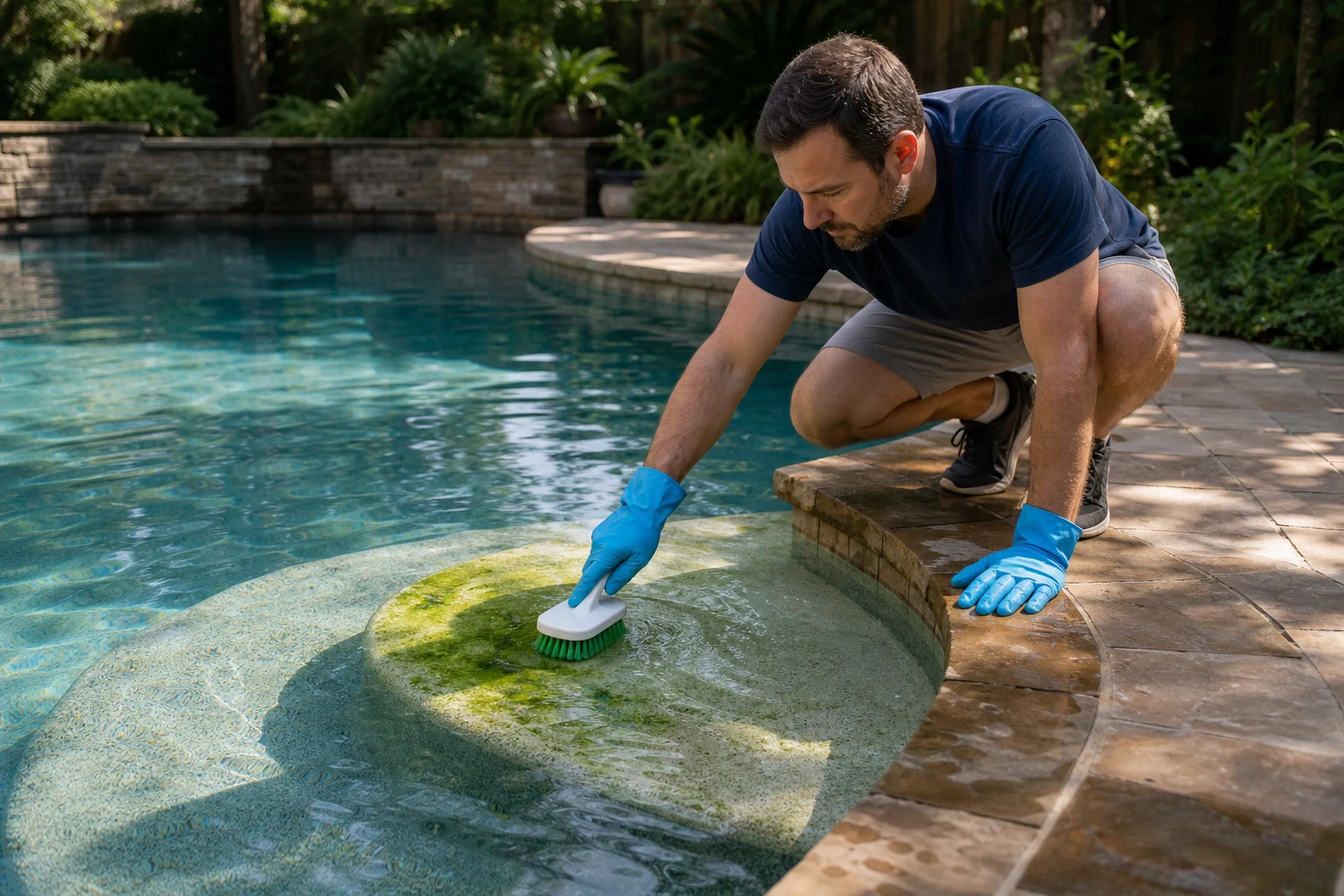
Confirm that the problem is algae
Green water or a slippery green film strongly suggests algae, but yellow or dark marks can also be pollen, metals, scale, organic stains, or surface damage. Brush a small area with a finish-compatible tool and observe whether material disperses. Check whether it returns in shaded corners, behind ladders, under steps, or near weak returns.
Cloudy water with no attached growth may be a filtration or balance problem. A professional stain test may be more appropriate than aggressive chlorination if marks do not brush away.
Find the operating failure
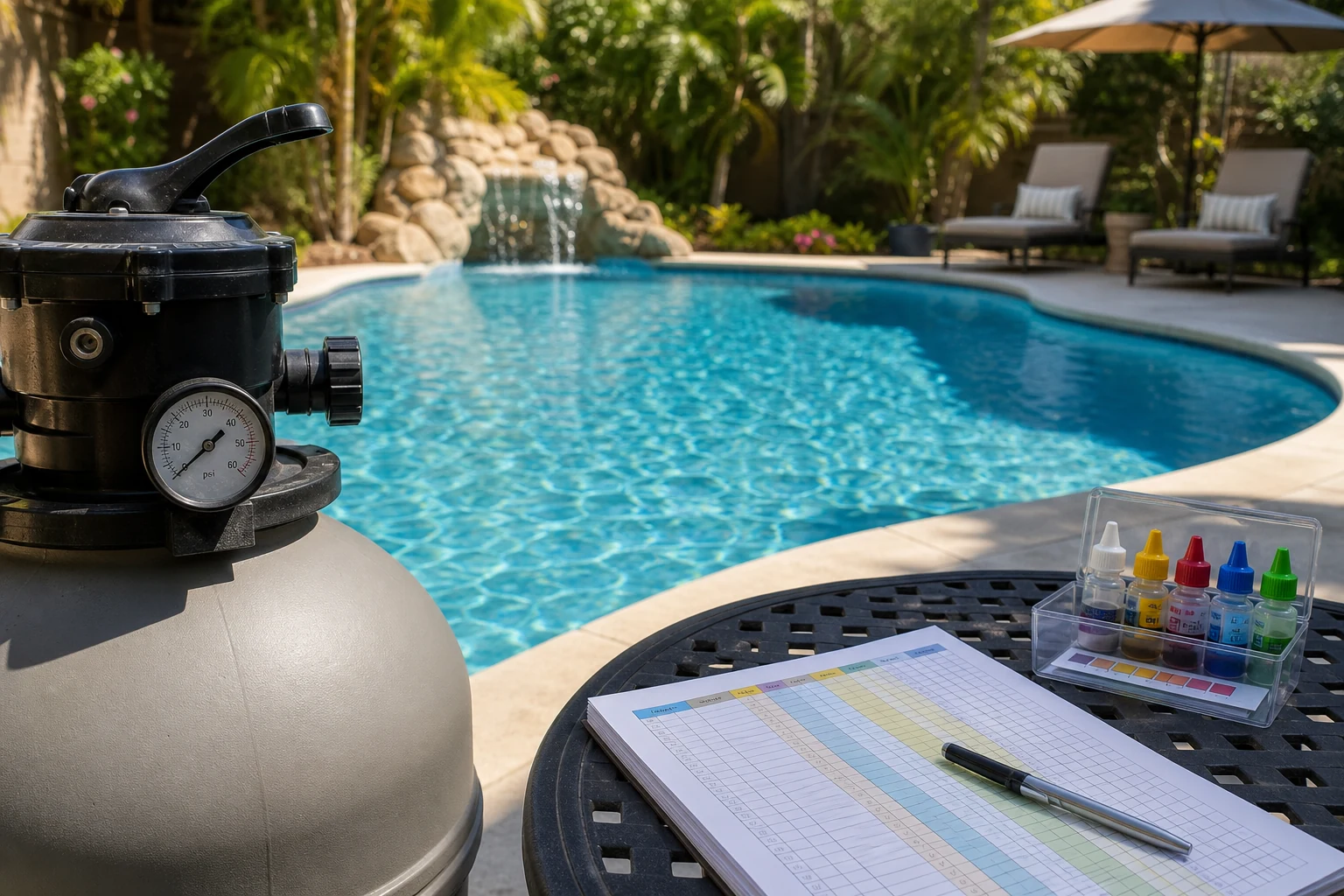
Test free chlorine and pH with a reliable kit. Measure cyanuric acid if stabilized chlorine is used because it changes the chlorine relationship. Check pump operation, valve positions, baskets, return flow, filter pressure, and the circulation schedule. Inspect the sanitizer feeder or saltwater generator, but do not rely on its status light as proof of a residual.
Review the previous week. Heat, sunlight, a storm, heavy swimming, debris, a power outage, low water level, a clogged basket, or an empty feeder can create the opening algae needs. Correcting the cause matters; otherwise the pool can turn again after treatment.
Remove as much growth as possible
Skim debris and brush affected surfaces thoroughly. Use a brush approved for the finish. Move ladders or removable fittings only if their instructions allow safe removal, because algae can hide behind them. Vacuum settled material with a method appropriate to the filter and the amount of debris.
Clean baskets and ensure the filter can operate. Do not automatically backwash a slightly dirty sand filter; use the pressure criterion. After treatment begins killing growth, filter loading may accelerate, so monitor pressure and flow more frequently.
Use a label-directed treatment
The required chlorine response depends on current free chlorine, pH, cyanuric acid, pool volume, sanitizer product, and the severity of growth. Use a product registered and labeled for the intended pool treatment. Calculate the dose from measured volume and follow application, circulation, protective-equipment, and re-entry instructions.
Do not combine chlorine with acid or another chlorine product. Do not mix a treatment bucket unless the label specifically directs it, and never pour water into a chemical container. More product is not automatically faster; an excessive dose can damage surfaces, liners, covers, equipment, and testing accuracy.
An algaecide may have a preventive or treatment role when its label supports the use, but it does not replace a disinfectant residual. Some copper-based products can stain hair or surfaces, while some foaming products create other cleanup problems. Identify the active ingredient and understand the tradeoff.
Filter, clean, and retest
Maintain the required circulation and brush again to expose remaining film. Vacuum debris and service the filter when pressure or the manual calls for it. Cartridge elements may need rinsing; sand or DE systems may need a controlled backwash and, for DE, correct media replacement.
Retest free chlorine and pH using a method valid at the current concentration. Very high chlorine can bleach a DPD test and look falsely low. Check cyanuric acid again if a large amount of stabilized chlorine was used or water was replaced.
Do not allow swimming simply because the water changed from green to blue. The deepest point and suction fittings must be clearly visible, disinfectant and pH must be in an acceptable range, and any product re-entry interval must have passed.
Prevent a repeat
Maintain a written test and maintenance log. Focus brushing on shaded, rough, and low-circulation areas. Keep vegetation and soil away from the edge, remove leaves promptly, and encourage swimmers to shower. Adjust pump speeds and return direction only within equipment limits so the pool has useful circulation rather than a high electric bill without good coverage.
Track cyanuric acid when using dichlor or trichlor. A pool with an excessive stabilizer level can look adequately chlorinated on a generic chart while having insufficient active disinfection for its conditions.
If algae returns despite verified chemistry and circulation, obtain a professional evaluation for hidden growth, filter bypass, inaccurate volume, dead zones, phosphate or nutrient issues, or a surface problem. Do not keep escalating chemical use without a diagnosis.
Final takeaway
Treat algae as evidence of a system failure, not just a color problem. Confirm the diagnosis, test chlorine, pH, and stabilizer, restore circulation and filtration, brush and vacuum, and use only label-directed treatment. Reopen the pool only after clarity and chemistry pass. Prevention is the less dramatic—and less expensive—version of the same fundamentals.
Sources and Supporting Claims
National Pesticide Information Center at Oregon State University
- Pool antimicrobial products control bacteria, algae, and viruses.
- Chemical labels and first-aid directions control safe handling.
- Cyanuric acid slows chlorine breakdown in sunlight.
Centers for Disease Control and Prevention
Published 2024-05-10
- Residential pools need routine free-chlorine and pH testing.
- CDC recommends pH 7.0 to 7.8 and provides minimum free-chlorine guidance.
- DPD kits are more accurate than strips and product directions control use.
U.S. Environmental Protection Agency WaterSense
Published 2026-06-01
- Skimming and vacuuming reduce load on filtration.
- Filters should be cleaned based on need and pressure rather than an arbitrary schedule.
- Pool equipment and plumbing should be drained before freezing weather where applicable.
- Automatic-fill systems should be monitored for leaks.