How should homeowners decide whether to repair or replace major pool equipment?
Repair when the failure is well diagnosed, parts are supported, safety is intact, and the repair restores useful service at a reasonable share of replacement cost. Replace when failures repeat, critical parts are obsolete, efficiency or compatibility materially improves, or the equipment cannot be returned to safe operation.
Repair-versus-replace decisions should compare a diagnosed repair with a complete installed replacement, not a service-call price with an online box price. Consider safety, failure cause, remaining life, parts, warranty, efficiency, compatibility, code, downtime, and the condition of the entire system.
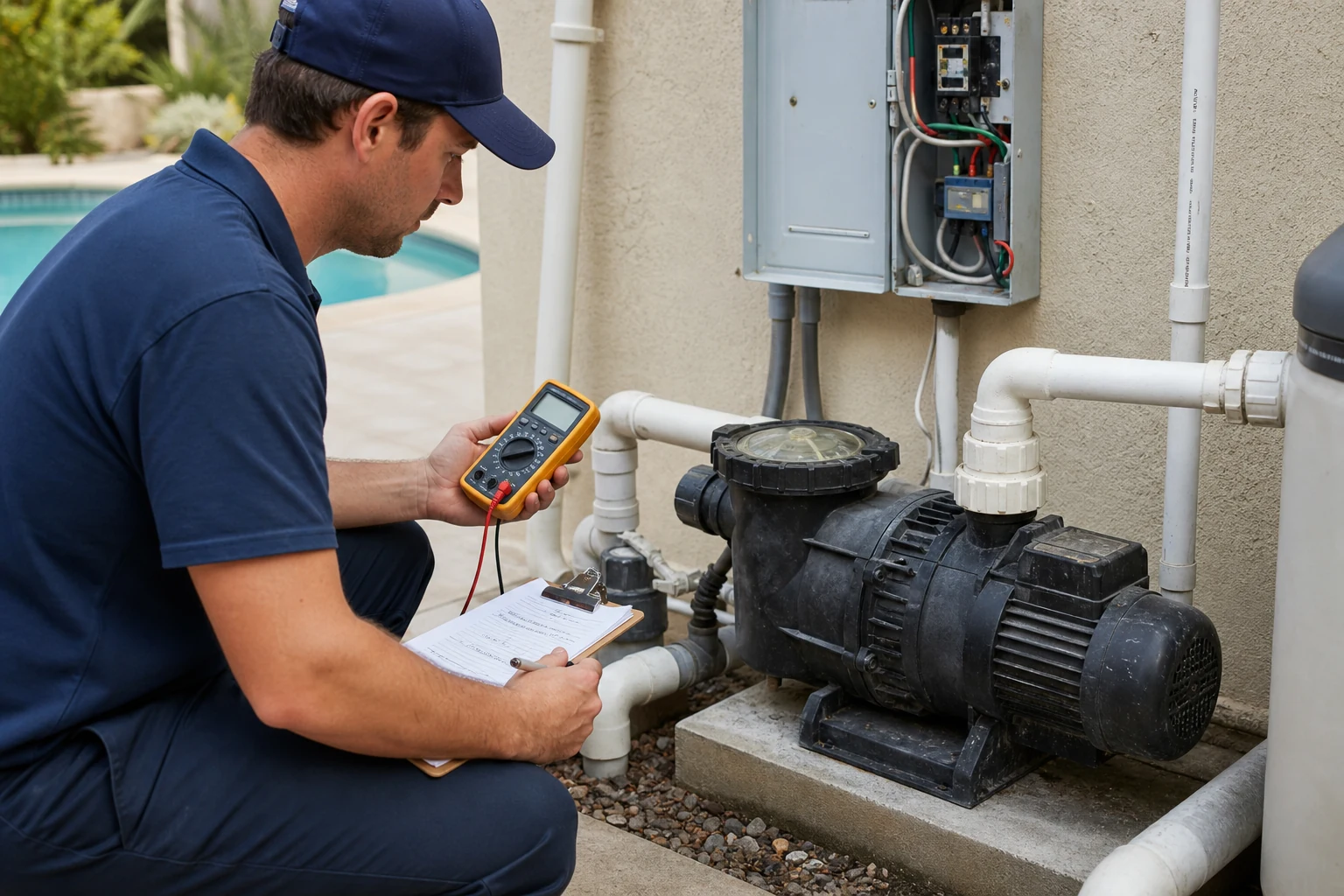
Pay for diagnosis before choosing
“The pump is bad” may describe a leaking seal, failed capacitor, damaged motor, obstructed impeller, cracked housing, wiring fault, or hydraulic problem. Each has a different repair. A heater fault may be flow, gas supply, ignition, scale, controls, or a heat exchanger.
Request symptoms, test results, failed part, probable cause, and safety status in writing. Ask whether another system condition caused the failure. Replacing a motor without correcting blocked plumbing can repeat the damage.
Define the repair
A useful repair quote identifies parts, labor, seals or consumables, warranty, tax, travel, and what happens if another defect appears after disassembly. Confirm whether the part is new, rebuilt, aftermarket, or obsolete stock.
Ask how the repair restores rated performance. A temporary patch to a cracked pressure vessel or damaged cord is not an acceptable life extension. Follow manufacturer service limits.
Define the complete replacement
The replacement cost includes equipment, removal, disposal, plumbing, valves, pad work, electrical or gas changes, bonding, permits, automation integration, programming, startup, and warranty. Internet retail price omits most of this.
Request the exact model and why it fits. Confirm pump curve, filter flow, heater requirements, voltage, breaker, gas capacity, controller protocol, clearances, and parts support. A nominal “equivalent” can create new incompatibilities.
Compare remaining life and failure history
Age alone does not decide. A well-supported housing with one replaceable motor failure may be a good repair. A corroded unit with repeated leaks, discontinued controls, and scarce parts may not.
Review service records. Repeated failures, rising noise, overheating, nuisance trips, leaking pressure vessels, combustion concerns, or damaged wiring weigh toward replacement. Cosmetic fading does not.
Include efficiency with realistic use
ENERGY STAR identifies substantial efficiency advantages for correctly operated variable-speed pool pumps compared with older single-speed designs. Estimate savings from actual watts, hours, speeds, and rates. Do not use the most optimistic marketing value.
For heaters, compare delivered efficiency under expected conditions and include cover use. A new efficient heater cannot overcome uncontrolled evaporation. For robots and automation, standby power may be less important than repairability and supported software.
Calculate simple annual energy difference, but also include maintenance, expected service, and utility upgrades. A long payback can still make sense when replacement is already required; it may not justify discarding functioning equipment.
Give safety and code priority
Replace equipment that cannot be returned to safe listed operation. Cracked filter tanks, unreliable closures, damaged underwater-light systems, compromised cords, corroded combustion components, or missing safety controls are not candidates for improvised repair.
A replacement can trigger current code requirements for GFCI, bonding, disconnects, gas, drainage, or efficiency. Have qualified trades evaluate the installation. Code cost is part of the project, not an optional add-on.
Account for downtime and season
A repair part that takes six weeks during swimming season may have a different value from one on the technician’s truck. Emergency replacement can narrow choices. If an aging component remains serviceable, planning off-season replacement may produce better bids and less downtime.
Ask about loaner equipment, temporary sanitation, and how the pool will be protected during an outage. Never let stagnant water become a safety or mosquito problem.
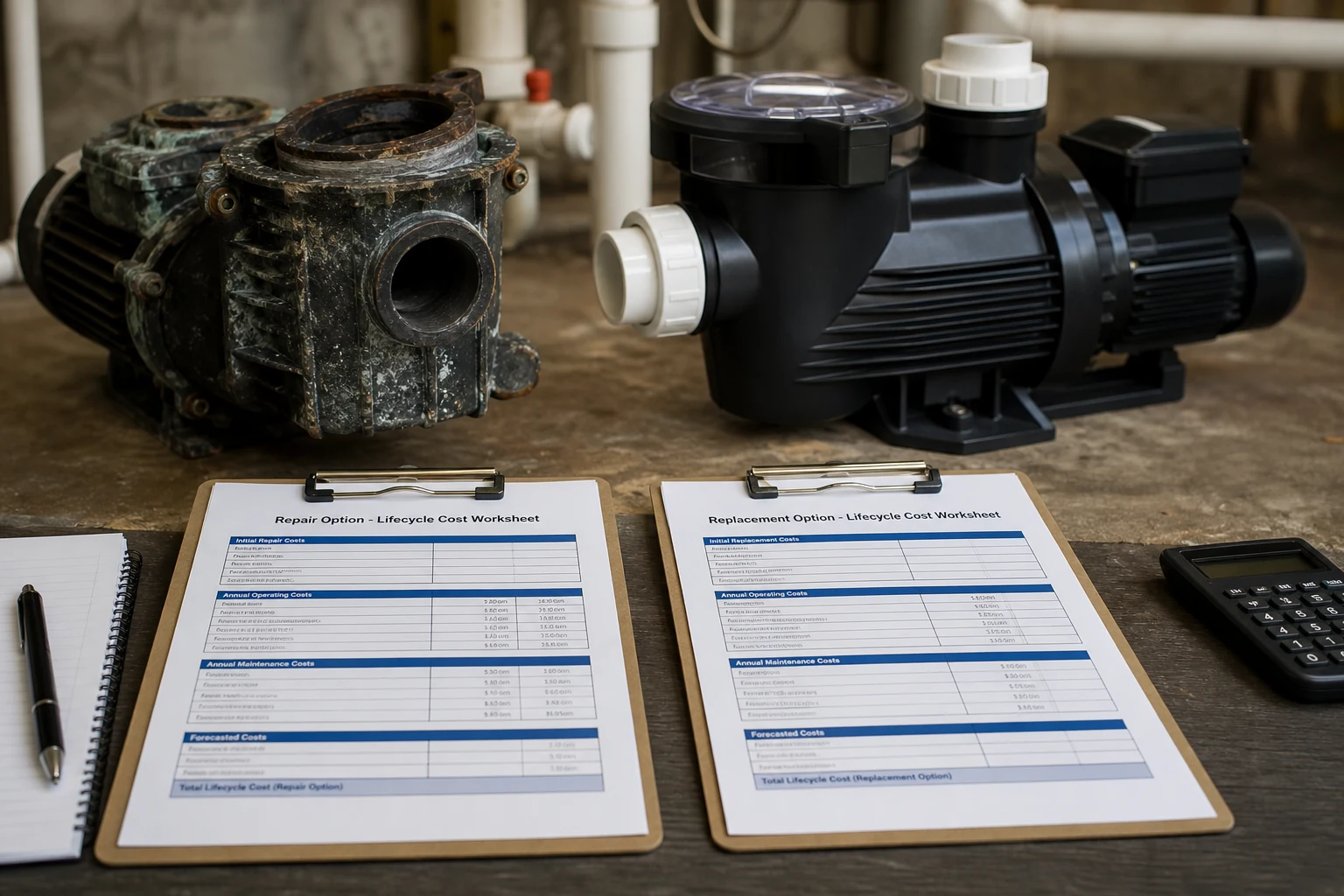
Use a decision worksheet
List: confirmed fault; safety status; repair scope and warranty; installed replacement scope and warranty; expected remaining service; parts support; annual energy; compatibility; code work; downtime; and consequence of another failure.
Compare a repair-cost percentage only after those rows are filled. Rules such as “replace if repair exceeds half” are shortcuts, not decisions. A low-cost repair on a dangerous obsolete unit is poor value; an expensive repair on a durable serviceable system may be reasonable.
Build a replacement reserve
Track installation dates, model and serial numbers, warranties, service, clean pressures, operating settings, and current replacement estimates. Set aside funds annually for major components. Update estimates because labor, equipment, and code change.
Final takeaway
Diagnose first. Repair when the equipment can be restored safely, parts are supported, the failure is isolated, and useful life remains. Replace when risk, repeated failures, obsolescence, compatibility, or efficiency makes the complete installed option stronger. A written system-level comparison prevents both premature replacement and false economy.
Sources and Supporting Claims
U.S. Environmental Protection Agency ENERGY STAR
- Variable-speed pumps can match speed to filtration and higher-flow tasks.
- Lower pump speed can substantially reduce power demand.
- Pump choice must be paired with preventive maintenance and correct system operation.
Pentair
- Filter disassembly and reassembly are safety-sensitive and model-specific.
- Poor clarity can reflect sanitizer, flow, sizing, media, or installation problems.
- The installed equipment manual controls service procedures.
U.S. Department of Energy
Published 2023-03-01
- Pool heaters are covered consumer products with federal energy-conservation standards.
- Efficiency comparisons should use the metric and conditions applicable to each heater type.