What should homeowners understand about chlorine in a residential pool?
Chlorine is a disinfectant, not a substitute for filtration or swimmer hygiene. Maintain an appropriate measurable free-chlorine residual, keep pH in range, test routinely, and use one labeled product at a time without mixing chemicals.
Chlorine protects swimmers by inactivating many germs, but it does not work instantly and it does not replace filtration, brushing, or healthy swimmer behavior. Homeowners need to understand free chlorine, combined chlorine, pH, stabilized products, and safe handling. The product label controls dosing, protective equipment, storage, and re-entry.
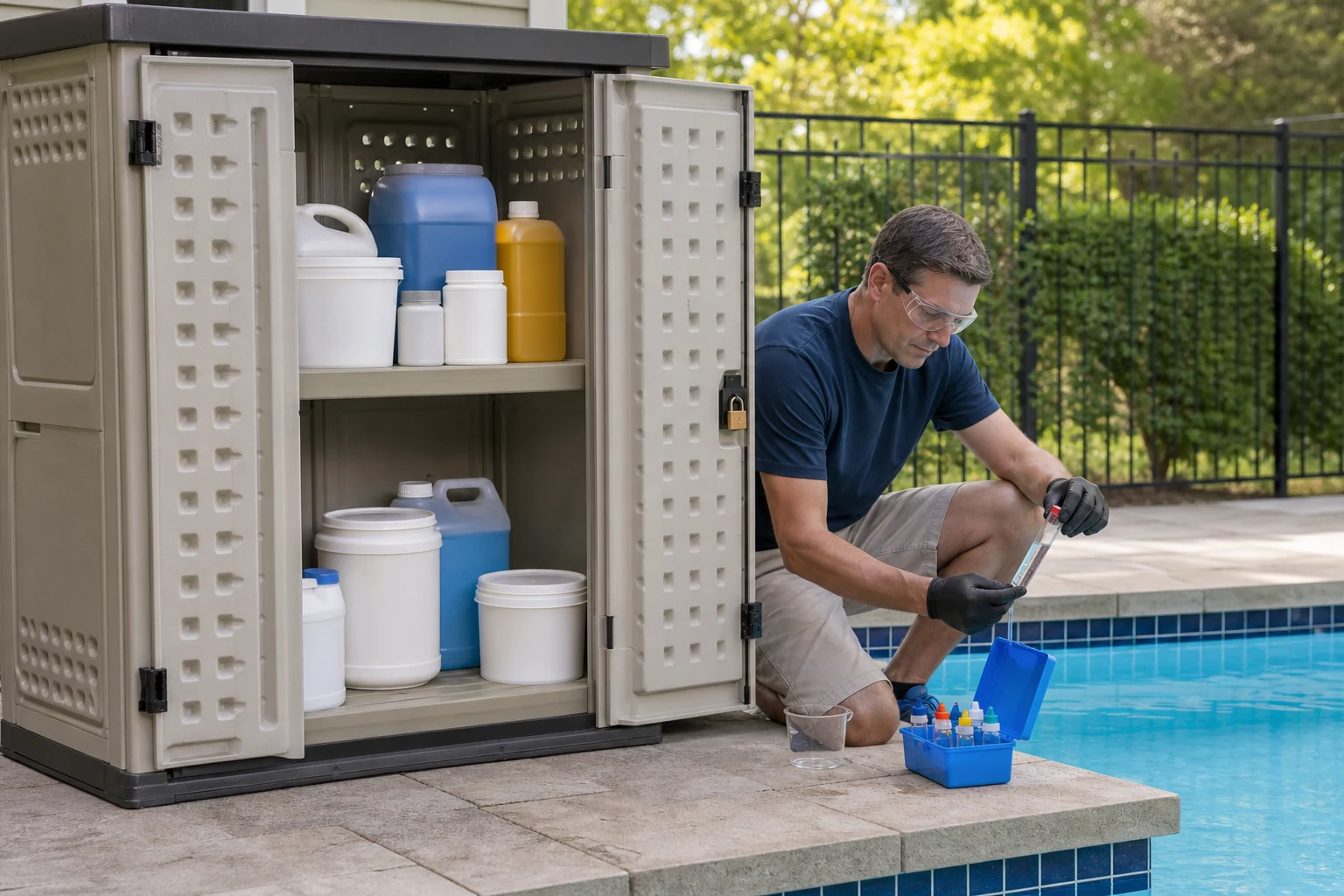
Free chlorine is the working residual
When chlorine products dissolve, they create disinfecting chemistry in the water. “Free chlorine” is the measurable portion available to act on contaminants. “Total chlorine” includes free chlorine plus combined forms. The difference is commonly described as combined chlorine.
Combined chlorine can include chloramines formed when chlorine reacts with sweat, urine, cosmetics, and other nitrogen-containing material. CDC explains that chloramines can irritate eyes and the respiratory tract, especially in poorly ventilated indoor environments. A strong “chlorine” odor is not proof that a pool has too much useful free chlorine; it often signals contamination and combined chlorine.
pH changes chlorine performance
Chlorine and pH must be interpreted together. CDC recommends pH 7.0–7.8 for home pools and notes that high pH reduces chlorine’s germ-killing effectiveness. Very low pH can be corrosive to equipment and uncomfortable for swimmers.
That does not mean homeowners should add acid whenever pH approaches the high end. Confirm the reading, evaluate total alkalinity and aeration, calculate for the actual volume, and follow one product label. Large back-and-forth adjustments create risk and unstable water.
Know what is in the product
Liquid sodium hypochlorite adds chlorine without cyanuric acid or calcium, but it degrades with heat and time and can raise salt over repeated use. Calcium hypochlorite is a concentrated dry sanitizer that also adds calcium. Dichlor and trichlor are stabilized chlorines that add cyanuric acid. Each has different concentration, pH effects, storage concerns, and application instructions.
Never identify a product only by a marketing term such as “shock.” Read the active ingredient and concentration. Two products with similar front labels can behave differently. Do not substitute one scoop for another or assume a feeder accepts every tablet.
Cyanuric acid changes the target
Cyanuric acid protects chlorine from sunlight in outdoor pools, but it also slows disinfection. CDC’s home-pool page recommends at least 2 ppm free chlorine when cyanuric acid or stabilized chlorine is used, compared with at least 1 ppm without it. Product labels, local rules, and system guidance may require a different operating relationship.
Because stabilized products add cyanuric acid repeatedly, test it separately. It does not evaporate with water. Splash-out and backwash remove some, while evaporation leaves it behind. If a verified concentration is too high, controlled water replacement is often the practical reduction method, subject to structural and local discharge limits.
Test more often when demand changes
Sunlight, heat, rain, leaves, dust, swimmers, and algae consume or dilute the measurable residual. Test during routine operation and increase frequency during heavy use or unusual weather. Automated feeders and saltwater generators reduce manual dosing but do not verify that the desired residual is present.
If a test reports zero, confirm the result before adding a large dose. High chlorine can bleach some DPD tests and produce a false low. Old reagents, sampling near a return, or reading outside the specified time can also mislead.
Handle chlorine products as reactive chemicals
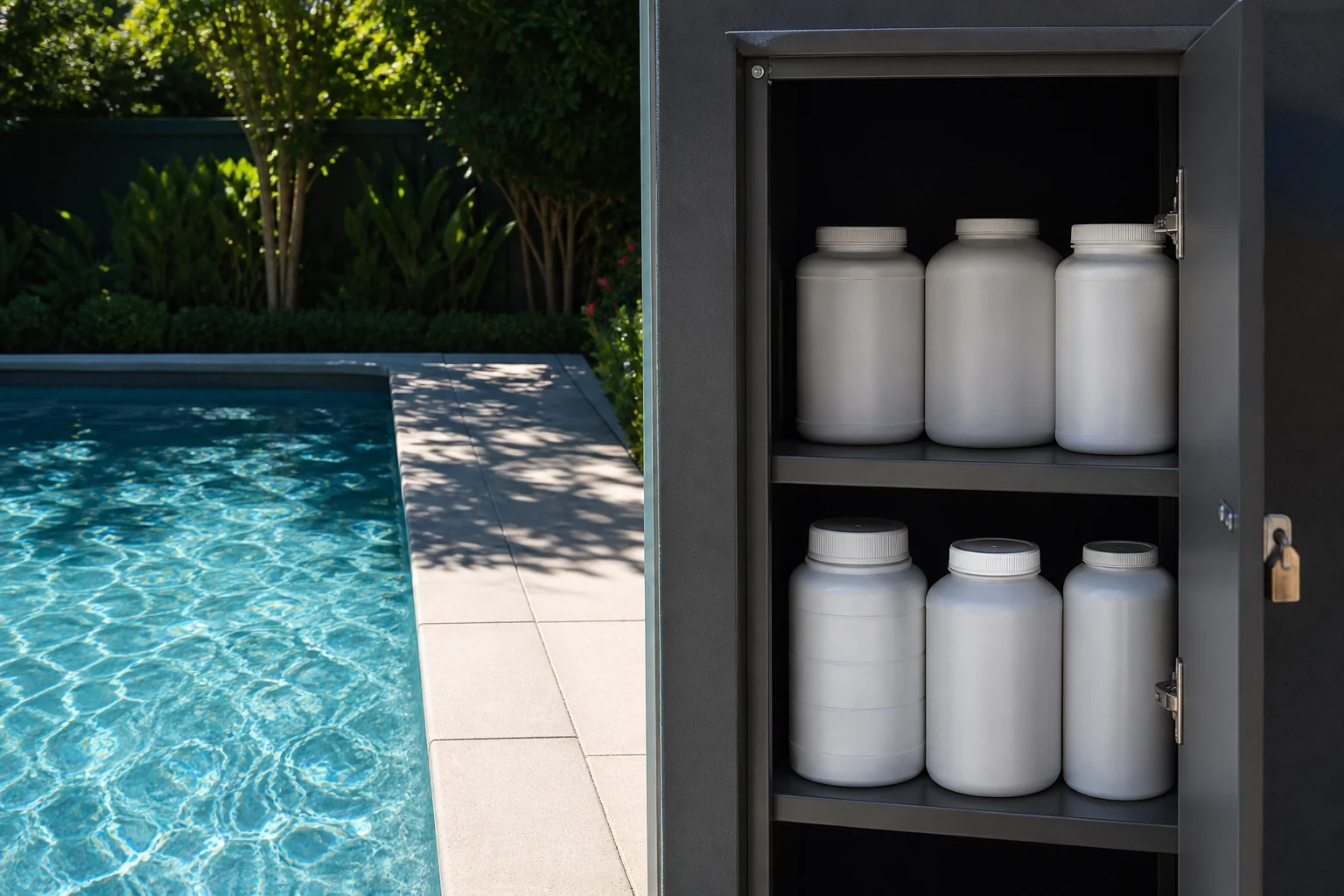
Keep products in their original labeled containers, closed and dry, in a secure location away from children and pets. Separate incompatible products according to their labels and local fire guidance. Moisture entering a dry-chlorine container can start a dangerous reaction.
Never mix chlorine with acid, ammonia, other chlorine products, or an unknown residue. Use dedicated, clean measuring tools if the label permits them. Do not add water into a chemical container. Wear the protective equipment on the label, open containers outdoors or in suitable ventilation, and stand upwind.
If a spill, fire, gas release, or exposure occurs, leave the area and follow the label’s emergency directions. Call emergency services or Poison Control as appropriate rather than attempting an improvised neutralization.
Chlorine cannot solve every water problem
Cloudiness can involve filtration, circulation, fine particles, high calcium saturation, contamination, or algae. Stains may be organic, metallic, or surface damage. A chlorine dose is not a universal diagnostic tool.
Mechanical cleaning and swimmer hygiene reduce demand. Encourage a quick shower, keep sick swimmers—especially anyone with diarrhea—out, remove debris, maintain the filter, and prevent animals from entering. These practices help the available sanitizer do its actual job.
Final takeaway
Manage chlorine as a measured residual within a complete system. Test free chlorine and pH, account for cyanuric acid, know the active ingredient, and use only label-directed doses. Secure and separate products, never mix them, and verify unusual results. Safer use means fewer dramatic corrections and more consistent protection.
Sources and Supporting Claims
Centers for Disease Control and Prevention
Published 2024-05-10
- Residential pools need routine free-chlorine and pH testing.
- CDC recommends pH 7.0 to 7.8 and provides minimum free-chlorine guidance.
- DPD kits are more accurate than strips and product directions control use.
Centers for Disease Control and Prevention
Published 2025-06-23
- Chloramines form when chlorine combines with swimmer waste.
- Chloramines can irritate eyes and the respiratory tract.
National Pesticide Information Center at Oregon State University
- Pool antimicrobial products control bacteria, algae, and viruses.
- Chemical labels and first-aid directions control safe handling.
- Cyanuric acid slows chlorine breakdown in sunlight.