What should a homeowner do every week to maintain a residential pool?
A useful weekly routine starts with a visual and equipment check, then removes debris, confirms circulation, tests water, and records what changed. Conditions—not the calendar alone—should determine filter cleaning and chemical additions.
A good pool-care week is not a race to add chemicals. It is a short, repeatable inspection that tells you what the pool actually needs. Start with safety and observation, remove debris, confirm that water is moving normally, test the water, and record the result. That sequence helps you catch a loose gate, leaking union, blocked basket, rising filter pressure, or falling sanitizer before it becomes a larger repair or water-quality problem.
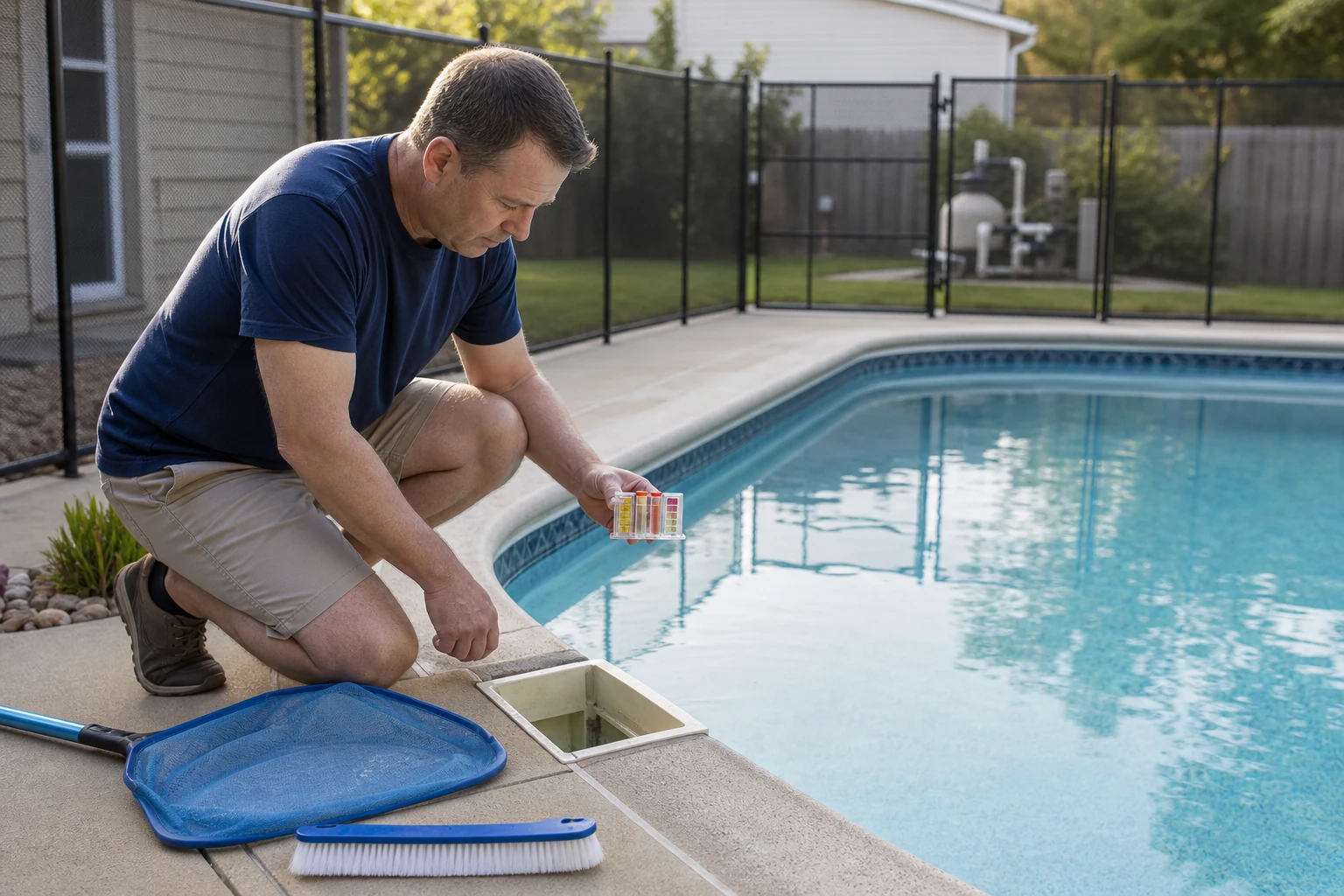
Begin with the pool area, not the chemical shelf
Walk the pool perimeter while the light is good. Confirm that fences, gates, door controls, covers, and alarms are in working order. Move climbable furniture or toys away from barriers. Look for cracked drain covers, loose coping, damaged handrails, sharp edges, or deck settlement. If an underwater light flickers or anyone reports tingling in the water, keep people out and have the electrical system evaluated rather than treating it as a routine maintenance issue.
Next, look at the water. You should be able to see the bottom clearly. Note a change in color, a dull surface, floating debris, foam, an oily waterline, or patches on walls and steps. A clear pool can still have poor chemistry, but a sudden visual change is useful evidence. Photograph unusual stains or water loss so you can compare them later instead of relying on memory.
Remove debris in the right order
Empty skimmer and pump-strainer baskets before they become packed enough to restrict flow. Turn equipment off and follow the equipment manual before opening a pump lid. Skim leaves and insects from the surface before they sink. Brush walls, steps, corners, behind ladders, and other low-circulation areas so attached film becomes available to the sanitizer and filter. Vacuum settled debris after brushing.
This order matters. Vacuuming first and brushing afterward simply puts more material on the floor. Likewise, leaving leaves in a basket can reduce circulation even when the pump still sounds normal. Landscaping, wind, pollen, storms, and swimmer load determine how often cleaning is needed; a tree-lined yard may need attention several times a week, while an enclosed pool may need less.
Check circulation and equipment behavior
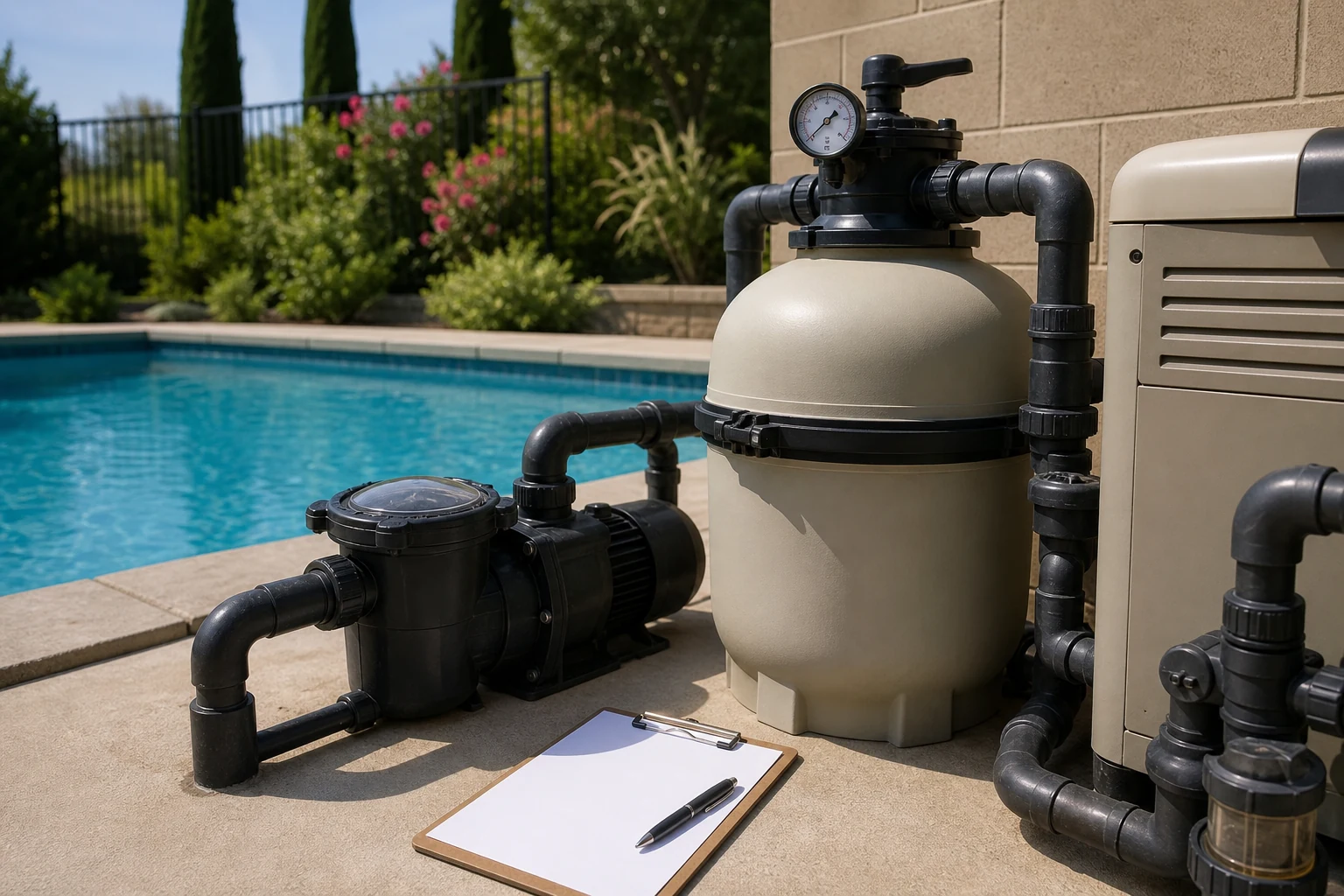
With the system operating, inspect the pump, filter, heater, chlorinator, valves, and visible plumbing. Look for drips, air under a clear pump lid, unusual vibration, a change in sound, or weak return flow. Do not place hands near moving components or open a pressurized filter. Record the filter pressure after the system has stabilized and compare it with the clean-filter baseline established after proper service.
Pressure alone does not diagnose every problem. Rising pressure can indicate accumulating debris, while unusually low pressure can point to restricted suction, a blocked basket, a low water level, an air leak, or a gauge problem. Clean or backwash the filter when the installed model’s instructions and actual operating evidence call for it. The U.S. Environmental Protection Agency’s WaterSense guidance specifically favors need-based cleaning over an arbitrary calendar because unnecessary backwashing wastes water.
Test before adjusting
Test free chlorine and pH using a reliable method and follow the test manufacturer’s timing and storage directions. CDC guidance for home pools emphasizes routine checks of both values because disinfectant performance and swimmer comfort depend on them together. Testing frequency should increase during hot weather, heavy use, storms, or any period when readings change rapidly.
Depending on the pool and treatment system, the weekly log may also include total alkalinity and, where stabilized chlorine is used, cyanuric acid. Calcium hardness and salt are commonly tested less often unless startup, water replacement, scaling, corrosion, or a system warning justifies a check. Do not add several corrective products at once. Verify an unexpected result, calculate the dose for the actual water volume, follow one product label, circulate as directed, and retest.
Track water level and water use
Mark or photograph the normal water level. Evaporation changes with wind, temperature, humidity, cover use, and water features, so a single low reading does not prove a leak. A pattern does. Check the automatic fill valve if one is installed, and look for water at equipment, waste lines, or the downhill side of the pool.
A cover can reduce evaporation and heat loss when it is appropriate for the pool and used correctly. It must not be described as a safety cover unless it is designed, installed, and maintained for that purpose. Keep any cover dry, functional, and secured according to its instructions.
Keep a two-minute maintenance record
Write down the date, water appearance, water level, free chlorine, pH, filter pressure, cleaning performed, chemical additions, and anything unusual. Include weather or a large pool party when it explains a change. A short log makes trends visible: gradually rising pressure, repeated low sanitizer, frequent refilling, or a pump that is becoming noisier.
The record also improves professional service. A technician can make a better diagnosis when you can show when the symptom started, how equipment readings changed, and what was added to the water. Keep product labels, model numbers, manuals, and service invoices with the log.
Final takeaway
The most useful weekly checklist is consistent but not rigid. Inspect safety barriers and the water, remove debris, verify circulation, test before dosing, watch the water level, and record the evidence. Let actual conditions and the installed equipment manuals determine extra work. That approach protects swimmers, avoids unnecessary chemicals and backwashing, and turns small changes into early warnings rather than expensive surprises.
Sources and Supporting Claims
U.S. Environmental Protection Agency WaterSense
Published 2026-06-01
- Skimming and vacuuming reduce load on filtration.
- Filters should be cleaned based on need and pressure rather than an arbitrary schedule.
- Pool equipment and plumbing should be drained before freezing weather where applicable.
- Automatic-fill systems should be monitored for leaks.
Centers for Disease Control and Prevention
Published 2024-05-10
- Residential pools need routine free-chlorine and pH testing.
- CDC recommends pH 7.0 to 7.8 and provides minimum free-chlorine guidance.
- DPD kits are more accurate than strips and product directions control use.
U.S. Environmental Protection Agency WaterSense
Published 2026-03-06
- Pools lose water through evaporation, cleaning, leaks, and splash-out.
- Consistent pool-cover use can greatly reduce evaporation and heat loss.
- Water-efficient maintenance can reduce water, energy, and chemical use.